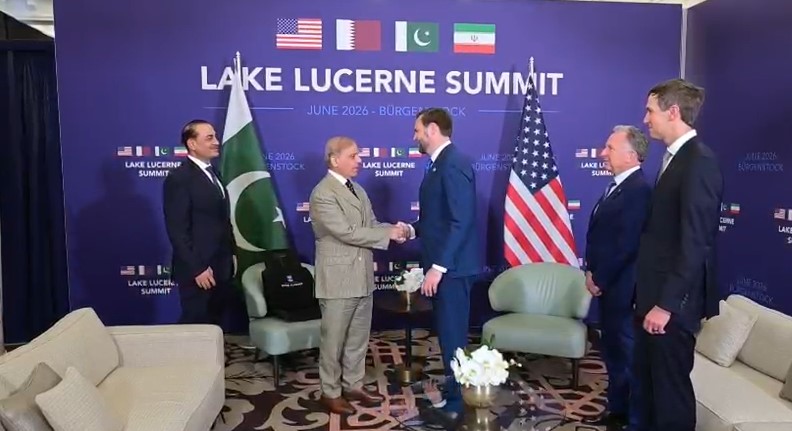
BÜRGENSTOCK, Switzerland: US Vice President JD Vance met Prime Minister Shehbaz Sharif and Chief of Defence Forces and Chief of Army Staff Field Marshal Syed Asim Munir on Sunday ahead of high-level technical negotiations between the United States and Iran aimed at implementing the Islamabad Memorandum of Understanding (MoU).
The meeting, held in a cordial atmosphere at the Swiss resort of Bürgenstock, was also attended by senior US envoys Jared Kushner and Steve Witkoff.
According to diplomatic sources, discussions focused on the implementation framework of the recently concluded Islamabad MoU, with Vance appreciating Pakistan’s role in facilitating dialogue between Washington and Tehran and helping bring both sides back to the negotiating table.
The meeting followed the signing of a framework agreement earlier this week between the United States and Iran aimed at ending a four-month military conflict that had disrupted global energy markets and heightened economic uncertainty.
Under the Islamabad MoU, Washington and Tehran agreed to observe a 60-day ceasefire while continuing negotiations on Iran’s nuclear programme and broader regional security issues.
The agreement also provides for the lifting of the US economic blockade on Iran and the reopening of the Strait of Hormuz to commercial shipping.
Pakistan played a key mediating role by maintaining diplomatic engagement with both countries and facilitating backchannel negotiations that led to the agreement.
The Bürgenstock talks mark the first formal phase of implementing the memorandum, with technical teams seeking to preserve the ceasefire and address operational issues amid continuing regional tensions.
The negotiations come as fresh uncertainty emerged after Iran’s Islamic Revolutionary Guard Corps announced the closure of the Strait of Hormuz following Israeli strikes in Lebanon. However, the US military said commercial shipping through the strategic waterway continued without interruption.
The renewed tensions have complicated efforts to advance the interim agreement signed by US President Donald Trump and Iranian President Masoud Pezeshkian to end nearly four months of conflict.
Vance arrived at the Bürgenstock resort after landing at Emmen Air Base earlier in the day, accompanied by Second Lady Usha Vance. Security was heightened throughout the area, with extensive checkpoints and helicopter patrols in place.
Before departing Washington, Vance expressed optimism about the negotiations.
“I think we’re going to hopefully make progress on the nuclear issue, make progress on the Lebanon ceasefire issue,” he told reporters, adding that the discussions could continue for “a couple of days.”
Iran’s Revolutionary Guards warned that vessels approaching the Strait of Hormuz could face risks, accusing Israel of violating ceasefire commitments through continued military operations in Lebanon.
Despite the warning, US Central Command said 55 merchant vessels carrying more than 17 million barrels of oil transited the strait on Saturday and pledged to ensure freedom of commercial navigation.
President Donald Trump said vessels would not be charged for passing through the strait during the ceasefire period or after a final agreement, unless negotiations ultimately collapsed.
In a social media post, Trump suggested the United States could consider imposing future transit fees “for services rendered as the Guardian Angel to the countries of the Middle East” if peace efforts failed.
Meanwhile, Mohammad Mokhber, an adviser to Iran’s Supreme Leader Ayatollah Ali Khamenei, accused Washington of failing to fully implement key provisions of the agreement, including a comprehensive ceasefire across all fronts.
He warned that regional energy flows would remain vulnerable until all commitments were honoured.
Iranian Oil Minister Mohsen Paknejad, however, said significant investment opportunities could emerge if Western countries adhered to the agreement, according to the ministry’s news outlet.