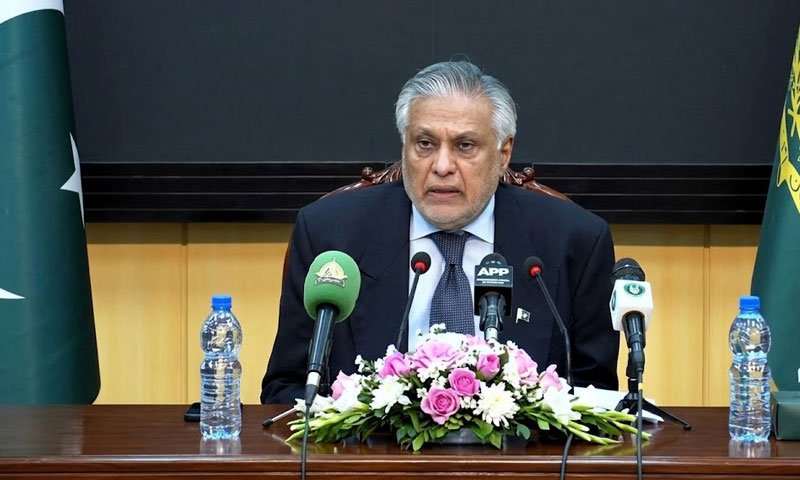
ISLAMABAD: United Nations Secretary-General António Guterres has accepted Prime Minister Shehbaz Sharif’s invitation to visit Pakistan, with the visit expected to take place before the end of his tenure, Deputy Prime Minister and Foreign Minister Ishaq Dar said on Friday.
Briefing the media at the Foreign Office on the prime minister’s recent visit to New York for the high-level week of the 81st session of the United Nations General Assembly (UNGA), Dar said Islamabad would announce the programme for the visit soon.
He described Guterres as a strong supporter of Pakistan, particularly during climate-related disasters, and expressed hope that his visit would be memorable.
“Very soon, we will release the programme and he will visit Pakistan on the prime minister’s invitation,” Dar said.
Prime Minister Shehbaz led Pakistan’s delegation during the UNGA session and held a series of bilateral meetings and high-level engagements on the sidelines of the gathering. The general debate of the 81st session was held from September 22 to 26, with an additional sitting on September 28.
Dar said the prime minister’s address presented Pakistan’s position on major regional and international issues, including Palestine, Jammu and Kashmir, water disputes, Afghanistan and efforts to promote peace through dialogue.
He said Shehbaz reiterated Pakistan’s unequivocal support for Palestine and presented Islamabad’s position on Jammu and Kashmir. The prime minister also highlighted Pakistan’s stance on its recent conflict with India and the Indus Waters Treaty.
According to Dar, the address also covered Pakistan’s diplomatic efforts to facilitate dialogue between the United States and Iran, as well as the impact of disruptions around the Strait of Hormuz and Bab al-Mandab on energy supplies and global prices.
“The impact of these developments was also felt in Pakistan, with oil prices almost doubling,” Dar said.
The prime minister also highlighted the security challenges posed by terrorism originating from Afghanistan and discussed developments involving Iran, Saudi Arabia, the Houthis and Iraqi militias, Dar added.
Pakistan’s diplomatic efforts
Dar described Pakistan’s efforts to facilitate dialogue between Washington and Tehran as a significant diplomatic development, saying Islamabad had helped bring the two sides to the negotiating table after 47 years.
He referred to the talks held in Islamabad in April, during which six sessions took place over two days, including consultations and breaks.
The deputy prime minister said the prime minister acknowledged the diplomatic efforts of Pakistan’s armed forces leadership and the Foreign Office in facilitating contacts between the United States and Iran.
Dar also highlighted Pakistan’s role in promoting multilateralism and the peaceful settlement of disputes during its elected membership of the UN Security Council.
He said Pakistan’s two-year term on the council would conclude on December 31, recalling that Islamabad had also held the council’s presidency in 2025.
According to Dar, a resolution on multilateralism and the peaceful settlement of disputes presented by Pakistan was unanimously adopted by the Security Council after a gap of 12 years.
He also highlighted Pakistan’s efforts to strengthen cooperation between the Organisation of Islamic Cooperation (OIC) and the United Nations, saying a statement adopted under Pakistan’s presidency had received unanimous approval.
Dar said a resolution adopted during Pakistan’s tenure had subsequently been cited in connection with the Thailand-Cambodia conflict.
Meetings with world leaders
Dar said Prime Minister Shehbaz participated in several high-level events during his stay in New York, including a meeting marking the 40th anniversary of the Declaration on the Right to Development and a gathering focused on China’s Global Development Initiative.
He said the prime minister was among the speakers invited to address the event on the Chinese initiative launched by President Xi Jinping.
Shehbaz also attended a reception hosted by US President Donald Trump for heads of delegations participating in the UNGA session. Dar said the two leaders interacted during the event and that the White House subsequently released photographs, including one showing them together.
The prime minister also held bilateral meetings with the UN secretary-general, the Emir and Prime Minister of Kuwait, and the presidents of Kenya, Iran and Syria, Dar said.
Other engagements included meetings with the chair of the presidency of Bosnia and Herzegovina, Bangladesh Prime Minister Tarique Rahman and the Lebanese prime minister.
Dar described the meeting with the Bangladeshi prime minister as warm and cordial, while the Lebanese premier appreciated Pakistan’s role in supporting ceasefire efforts during the US-Iran conflict, he said.
Pakistan had worked to ensure that ceasefire arrangements also covered Lebanon, Dar added.
The prime minister also met the presidents of the European Commission and the European Council to discuss bilateral trade and economic relations between Pakistan and the European Union.
The discussions covered the Generalised Scheme of Preferences Plus (GSP+) arrangement, including the transition from the existing framework to the next phase beginning in 2029.
IMF, business community engagements
Dar said Prime Minister Shehbaz also held a meeting with the managing director of the International Monetary Fund, who appreciated Pakistan’s efforts to implement structural reforms and acknowledged the progress made.
The prime minister also met Prince Rahim Aga Khan, following the latter’s recent visit to Pakistan, Dar said.
The Pakistani delegation further interacted with Pakistani-American business leaders and representatives of the US-Pakistan Chamber of Commerce and Industry, including business representatives associated with major international companies operating in the United States.
Dar said the visit involved an extensive programme of bilateral and multilateral engagements aimed at presenting Pakistan’s position on regional and global developments, advancing national interests and strengthening diplomatic and economic ties.
Fuel relief measures
Dar said the government had approved relief measures for motorcycle, three-wheeler and small-car users despite financial constraints and the requirements of the International Monetary Fund programme.
He said meetings on the fuel relief scheme had been held before and after the prime minister’s departure for New York, adding that millions of people were benefiting from the initiative.
The deputy prime minister described the scheme as an important measure aimed at providing relief to citizens amid rising fuel costs.