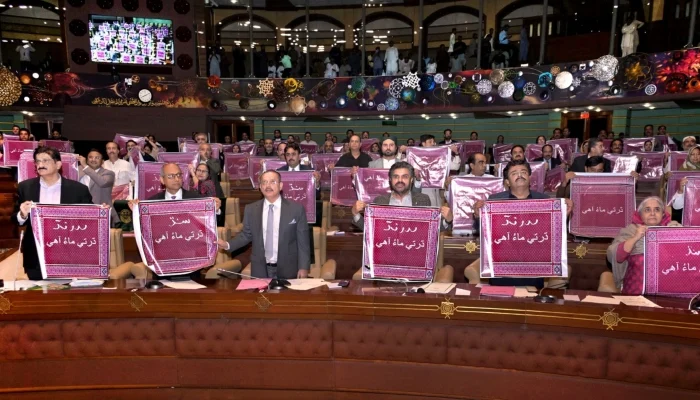
KARACHI: Amid a boycott by the Muttahida Qaumi Movement-Pakistan (MQM-P), the Sindh Assembly on Thursday unanimously passed a resolution rejecting any proposal, plan or constitutional arrangement aimed at dividing the province, altering its territorial boundaries or creating new administrative units.
The resolution was moved by Pakistan Peoples Party (PPP) lawmaker Nisar Ahmed Khuhro following days of debate on an adjournment motion concerning any move to divide Sindh.
As many as 137 lawmakers from both sides of the aisle participated in the discussion.
The resolution cited Article 239(4) of the Constitution, stating that no constitutional amendment seeking to alter the limits of a province can be presented to the president unless it has first been passed by a two-thirds majority of the provincial assembly concerned.
The House declared that the Sindh Assembly does not and shall not consent to any such alteration of the province’s territorial boundaries.
Reflecting on Sindh’s civilisational identity and its historic role as the first provincial legislature to pass a resolution in support of Pakistan in 1943, the assembly declared that Sindh is one and shall remain one.
The House, where the PPP holds a two-thirds majority, also rejected any proposal to detach a district, division or region from Sindh or place any part of the province under federal or separate administrative control.
It said all existing regions constituted an “integral and inseparable” part of Sindh.
“The resolution calls upon the Federal Government, Parliament and all political parties to respect the democratic will of the people of Sindh and refrain from entertaining any proposals that threaten provincial integrity,” the resolution stated.
The assembly directed the provincial government to send an official copy of the resolution to the president, prime minister, chairman of the Senate and speaker of the National Assembly to formally place Sindh’s constitutional position on the national record.
Constitutional rights
Concluding the debate, Sindh Chief Minister Syed Murad Ali Shah said Sindh had joined Pakistan as a single and united province and that its territorial integrity could not be altered against the will of its people or their elected representatives.
Murad said the PPP had initiated the debate in response to recent statements by certain political leaders advocating the creation of new provinces or separate administrative units.
He also criticised what he described as contradictory positions adopted by MQM-P leaders and other political parties that publicly opposed the division of Sindh while simultaneously proposing separate assemblies, chief executives and governance structures for different divisions of the province.
The chief minister said Sindh had consistently defended its identity and constitutional rights throughout history, including during efforts to separate Karachi from Sindh in 1948 and the imposition of the One Unit scheme.
He maintained that the One Unit arrangement was wrong when it was imposed and remained wrong today, arguing that the assembly that endorsed it did not genuinely represent the people of Sindh.
MQM-P accuses PPP of political distraction
Strongly criticising the ruling PPP, Leader of the Opposition in the Sindh Assembly Ali Khurshidi accused the party of using sensitive issues to divert attention from administrative failures.
“Politics is fine, but drama should not be staged,” Khurshidi said.
Speaking before the MQM-P boycotted the proceedings, he questioned the need for the resolution, pointing out that the assembly had already passed similar resolutions against the division of Sindh in the past.
Khurshidi accused the PPP of repeatedly raising the issue to exploit an “emotional factor” and cover up what he described as “zero performance and unprecedented bad governance”.
“Everyone living in Sindh knows their performance is zero,” he said, claiming that Karachi was currently ranked among the worst cities in the world because of widespread administrative problems.
He added that even cabinet ministers had limited authority over their respective departments.
MQM-P calls for decentralisation
Addressing the debate over administrative structures, Khurshidi clarified that the MQM-P stood for administrative empowerment and decentralisation rather than the division of Sindh.
He said that following the 18th Amendment, powers should have been devolved to the local level to provide administrative units with genuine autonomy.
The MQM-P maintained that its demand for greater administrative empowerment should not be equated with any proposal to alter the territorial integrity of Sindh.
Despite the opposition and boycott, the Sindh Assembly proceeded with the resolution, formally placing its rejection of any territorial division of the province on the parliamentary record.