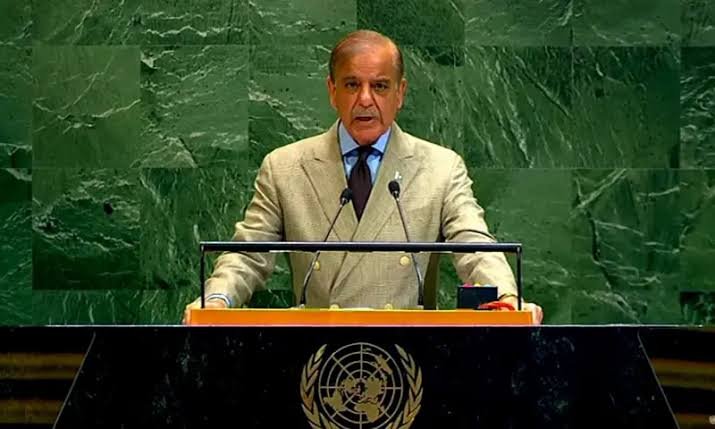
NEW YORK: Prime Minister Shehbaz Sharif on Friday told the United Nations General Assembly that Pakistan had chosen dialogue over confrontation and peace over war, calling for diplomatic efforts to resolve conflicts in the Middle East, Kashmir and Palestine.
Addressing the General Debate of the 81st session of the UN General Assembly, the prime minister said the world was living through a dangerous period but the future was not predetermined.
“We have chosen dialogue over confrontation. We have chosen cooperation over coercion. We have chosen peace over war,” Shehbaz said, stressing that preventing a war could require greater courage than starting one.
The prime minister outlined Pakistan’s position on major regional and global challenges, including the Middle East conflict, Palestine, Jammu and Kashmir, the Indus Waters Treaty, terrorism emanating from Afghanistan, climate change, economic pressures on developing countries and reform of the international financial and multilateral system.
On the Middle East, Shehbaz said that amid the continuing hostilities, the voice of diplomacy must be made louder. He recalled Pakistan’s efforts to bring the United States and Iran to dialogue in Islamabad, which led to the Islamabad Memorandum of Understanding.
He appreciated the efforts of Deputy Prime Minister and Foreign Minister Ishaq Dar and Field Marshal Syed Asim Munir in creating space for diplomacy under difficult circumstances.
The prime minister described the Strait of Hormuz and Bab al-Mandeb as vital arteries of the global economy and called for their reopening to facilitate connectivity and prosperity rather than becoming flashpoints of confrontation.
Shehbaz strongly condemned recent Houthi attacks against Saudi Arabia, particularly the attempted drone attack targeting Makkah Al-Mukarramah, and reaffirmed Pakistan’s solidarity with the kingdom.
He said any threat to the safety and sanctity of the Haramain Sharifain was a red line that must not be crossed.
Referring to the Makkah Joint Defence Agreement between Pakistan, Saudi Arabia and Türkiye, the prime minister said the arrangement was not directed against any country but represented a collective commitment to defence, stability and peace in the region.
Turning to South Asia, Shehbaz referred to last year’s conflict between Pakistan and India and said Pakistan had exercised its inherent right of self-defence. He praised the armed forces under the leadership of Field Marshal Syed Asim Munir and credited US President Donald Trump’s intervention with helping prevent a wider conflict.
He said lasting peace in South Asia was linked to a just and fair resolution of the Jammu and Kashmir dispute, noting that Kashmiris had waited decades for the United Nations to fulfil its commitment to a free and impartial plebiscite.
The prime minister alleged human rights violations in Indian-administered Jammu and Kashmir, including arbitrary detention, extrajudicial killings, enforced disappearances, sexual violence and collective punishment, and accused India of attempting to alter the territory’s status through demographic changes.
He assured the Kashmiri people of Pakistan’s continued diplomatic, political and moral support for their right to self-determination.
On the Indus Waters Treaty, Shehbaz described the Indus river system as the “lifeblood” of Pakistan and the wider region and said India’s decision to hold the treaty in abeyance had no legal basis.
He warned that any attempt to stop, impede or divert Pakistan’s share of the waters would be treated as an act of war.
“Water must never be weaponized. Rivers should nourish nations, not divide them,” the prime minister said.
On Palestine, Shehbaz highlighted the suffering of Palestinian civilians and referred to the deaths of children including Hind Rajab and eight-year-old Wafaa Akila.
He questioned whether a child born in Gaza deserved the same life, future and dreams as children elsewhere in the world.
The prime minister condemned the continuing violence in Gaza, the West Bank, Lebanon and Syria and reiterated Pakistan’s support for an independent, sovereign, viable and contiguous Palestinian state based on the pre-1967 borders, with Al-Quds Al-Sharif as its capital.
Addressing terrorism, Shehbaz said Pakistan had suffered major human and economic losses as a frontline state in the fight against terrorism.
He alleged that Afghan territory continued to be used by groups including the TTP and Balochistan Liberation Army to destabilise Pakistan and called on Afghan authorities to take verifiable and decisive action to prevent the use of their territory against Pakistan or any other country.
He also urged the Afghan authorities to respect the fundamental rights of the Afghan people, particularly women and girls.
The prime minister highlighted Pakistan’s contribution to UN peacekeeping and expressed concern over the rise of Islamophobia, including hate speech, attacks on mosques and desecration of the Holy Quran.
He also criticised what he described as the spread of religious hatred in the region and called for greater international action against Islamophobia.
On the economy, Shehbaz said Pakistan had achieved macroeconomic stability through structural reforms and fiscal discipline and was now working towards sustainable and inclusive growth.
He highlighted efforts to modernise agriculture and industry, develop mineral resources, digitalise the economy, equip young people with AI and IT skills and strengthen regional connectivity.
The prime minister also called for timely debt relief and affordable long-term financing for developing countries, while urging greater representation for developing nations in global financial institutions.
He appreciated China’s initiatives on global development, security, civilisation and governance and highlighted Pakistan’s cooperation with China through the China-Pakistan Economic Corridor as well as efforts to strengthen connectivity with the Gulf, Central Asia and other regions.
On climate change, Shehbaz said Pakistan contributed less than one per cent of global emissions but continued to face severe climate-related consequences.
He called on developed countries to fulfil their climate-finance commitments, provide funding for loss and damage and support adaptation and resilience efforts.
Concluding his address, the prime minister said restoring global trust required concrete action rather than words alone.
He called for a stronger and more effective United Nations and urged reform of the Security Council to make it more representative, democratic and accountable.
Reiterating Pakistan’s call for “Reform for All, Privilege for None”, Shehbaz urged the international community to choose peace, restore trust and work together despite divisions.
“Let us restore trust. Let us preserve peace. And let us prove that, even in a divided world, humanity can still choose to stand together,” he said.