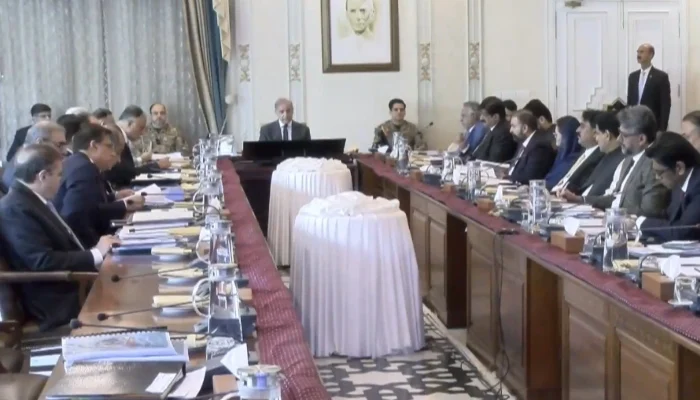
ISLAMABAD: Prime Minister Shehbaz Sharif on Wednesday praised the cooperation of provincial governments in tackling major economic challenges, saying Pakistan achieved macroeconomic stability through collective efforts and coordinated decision-making.
Addressing a meeting of the National Economic Council (NEC), the prime minister said the federal government took decisions in the best interest of the country through teamwork despite facing significant economic pressures.
“We made decisions in the best interest of Pakistan as a team,” the premier said, adding that the economy had encountered major challenges but succeeded in attaining macroeconomic stability.
Referring to the regional situation and its impact on global energy markets, PM Shehbaz said oil prices had risen sharply, prompting the government to provide Rs128 billion in fuel price relief to the public. He noted that while several countries experienced fuel shortages and long queues at petrol stations, Pakistan managed to maintain uninterrupted fuel supplies through timely measures.
The prime minister acknowledged the full support extended by provincial administrations in addressing economic issues and said the federal government had remained engaged in consultations with provinces for several weeks regarding the upcoming budget.
He said discussions focused on identifying additional financial resources and improving revenue generation, stressing that maximising available resources remained a key government objective.
PM Shehbaz also reiterated the government’s commitment to the International Monetary Fund (IMF) programme despite numerous challenges, saying efforts had been made to meet public expectations while maintaining economic discipline.
“We tried to meet the expectations of the people,” he said, adding that recent economic achievements were the result of collective teamwork.
Highlighting national security concerns, the prime minister said ensuring adequate resources for defence in the forthcoming budget was a priority. He added that additional funding would also be required to strengthen efforts against terrorism.
Briefing the meeting, Federal Minister for Planning Ahsan Iqbal said the NEC approved a national development budget of Rs3.66 trillion and set a gross domestic product (GDP) growth target of 4% for the next fiscal year.
According to Iqbal, the approved development package includes Rs1 trillion under the federal Public Sector Development Programme (PSDP), Rs2.21 trillion for provincial development spending, and Rs451 billion for federal state-owned enterprises.
The council also approved a proposal from the Ministry of Planning to hold NEC meetings on a quarterly basis.
The planning minister said development spending had declined significantly over the years, falling from 2.6% of GDP in 2018 to just 0.6%, and stressed the need for a “development emergency” to accelerate economic growth.
He noted that nearly 74% of government revenues were currently being consumed by debt servicing, while the external sector remained Pakistan’s most pressing economic challenge.
“We will have to increase foreign investment and exports,” Iqbal said.
The NEC approved sectoral growth targets of 3.6% for agriculture, 4.5% for industry and 4.2% for services. The inflation target for the next fiscal year was fixed at 8.2%.
Iqbal said water security had been identified as Pakistan’s top strategic priority, while adding that no new federal development projects would be initiated under the Rs1 trillion PSDP except those related to education and defence.