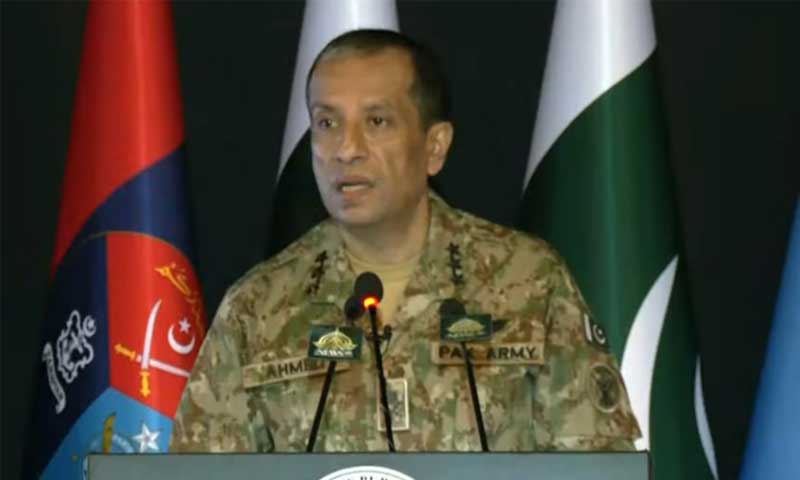
ISLAMABAD: Director General Inter-Services Public Relations (ISPR) Lieutenant General Ahmed Sharif Chaudhry on Friday said Pakistan’s security forces had killed 2,084 terrorists in counterterrorism operations this year, while reaffirming the military’s commitment to defeating terrorism, strengthening national unity and supporting the constitutional rights of the people of Kashmir.
Addressing a detailed press conference, the military spokesperson said security forces had carried out 7,177 intelligence-based operations in Khyber Pakhtunkhwa and 31,080 operations in Balochistan during the year as part of the country’s ongoing counterterrorism campaign.
He said 3,145 terrorism-related incidents had been recorded nationwide so far this year, adding that 819 people, including security personnel and civilians, had embraced martyrdom. According to the DG ISPR, the martyrs included 303 Pakistan Army personnel, 394 law enforcement officials and 322 civilians.
Lieutenant General Chaudhry said 28 suicide bombings had taken place this year, claiming Afghan nationals were involved in all such attacks, including incidents in Tank and Karachi.
He said the concept of a “hard state” should not be misunderstood, explaining that it referred to a state governed by the Constitution and the rule of law rather than military dominance.
“A hard state means a country where the Constitution is supreme, laws are implemented equally and elitism does not exist,” he said, adding that every citizen had a constitutional duty to remain loyal to the state before demanding individual rights.
Referring to recent remarks by Field Marshal Syed Asim Munir, the DG ISPR said discussions on rights should be accompanied by equal emphasis on citizens’ responsibilities.
“Our first and last identity must be Pakistani,” he said. “No ethnic, tribal or regional identity should take precedence over our national identity.”
Speaking on Azad Jammu and Kashmir, Lieutenant General Chaudhry described Kashmir as Pakistan’s “most beloved child,” saying the bond was rooted not only in constitutional provisions but also in Pakistan’s enduring commitment to the Kashmiri people.
“Kashmir and Pakistan are inseparable,” he said, reaffirming Pakistan’s longstanding support for the internationally recognised right of self-determination for the people of Jammu and Kashmir.
He accused India of pursuing multiple strategies in Indian Illegally Occupied Jammu and Kashmir, including financial incentives, a heavy military presence and legal measures, but claimed none had weakened the aspirations of the Kashmiri people.
“The decision of the Kashmiri people is settled. It is in their DNA,” he said.
Commenting on Interior Minister Mohsin Naqvi’s recent remarks regarding governance reforms, the DG ISPR said those comments were made in the minister’s personal capacity and declined to comment directly on them.
However, he stressed that good governance remained essential for Pakistan’s future, saying any administrative reforms should be undertaken through constitutional procedures and the democratic will of the people.
“There has to be a serious discussion on governance. If administrative reforms are needed, they must be carried out through constitutional means and by elected representatives,” he said.
Turning to Balochistan, Lieutenant General Chaudhry rejected what he described as a narrative of widespread deprivation in the province, arguing that the region had received significant investment in infrastructure, healthcare, education and development.
He said cities such as Gwadar and Turbat possessed facilities that exceeded those available in many other parts of the country relative to their populations.
The DG ISPR blamed the province’s longstanding challenges on the tribal system, alleging that certain influential groups sought to preserve the status quo by preventing education and economic progress.
“They do not want the poor man’s child to become a doctor, an engineer or an army officer. They want to maintain a system of dependency,” he said.
He further alleged that terrorist groups deliberately targeted schools, roads, railway infrastructure and other development projects to create a false narrative that Balochistan was being neglected.
“Terrorists attack development projects and then claim there is no development in Balochistan,” he said.
The military spokesperson also praised the Frontier Corps, police and other law enforcement agencies for successfully repelling attacks on police stations and public installations across the province, paying tribute to personnel who lost their lives while defending the country.
He said terrorists had repeatedly targeted soft civilian targets, including trains and development schemes, but security forces remained committed to eliminating terrorism and ensuring peace across Pakistan.