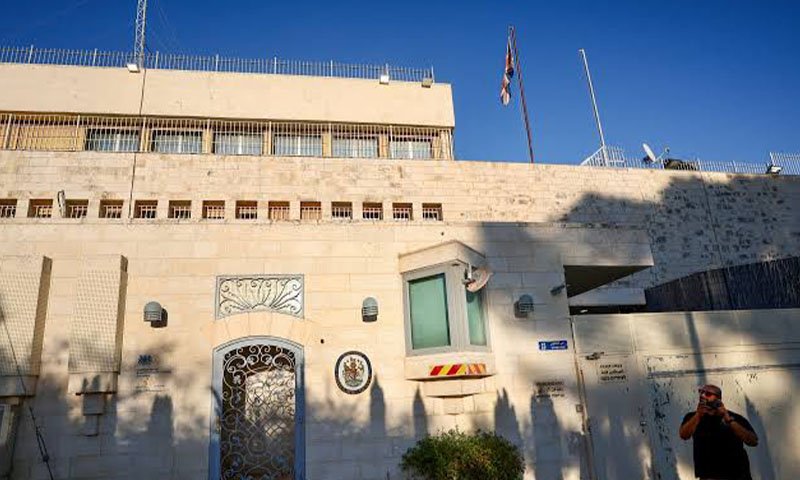
LONDON: Israel has ordered Britain to close its consulate in East Jerusalem within a month in retaliation for sanctions imposed by Britain, France and Canada on Israeli settlements, Israeli officials said on Wednesday.
Two Israeli officials and two other sources familiar with the matter said London had been given 30 days to shut the consulate, which represents Britain in Jerusalem, the West Bank and Gaza on Palestinian affairs.
The Israeli move comes after Britain, France and Canada announced measures targeting Israeli settlements, including restrictions on trade in settlement products.
The sanctions are among the strongest collective actions taken by major Western allies of Israel over its settlement policy and have triggered a strong backlash from the Israeli government.
Israel has also barred 12 British politicians from entering the country, ordered British officials and diplomats working in the West Bank and at a Gaza coordination centre in Israel to leave, and said Britain would no longer be permitted to train Palestinian security forces in the West Bank.
Israel has not announced similar retaliatory measures against France or Canada, which joined Britain in announcing restrictions on settlement trade, or against nine other countries that endorsed the British action.
British foreign secretary defends sanctions
British Foreign Secretary Ed Miliband said he regretted Israel’s decision to order the consulate’s closure but said the move had not come as a surprise.
“We weighed the costs and benefits of acting and we thought we simply could not stand by because we feared Israeli action,” Miliband told BBC television.
Miliband, who has described himself as a “proud British Jew”, said Britain’s decision was aimed at keeping alive the possibility of a two-state solution to the Israeli-Palestinian conflict.
He accused Israel of having “turned a blind eye” to violence by Israeli settlers against Palestinians.
Britain has also announced measures targeting companies and individuals providing services to Israeli settlements, including construction, infrastructure, financing and real estate.
Israeli Foreign Minister Gideon Saar described the British measures as “morally distorted” and accused London of interfering in Israel’s affairs and electoral process.
He later thanked Conservative Party leader Kemi Badenoch for criticising the sanctions.
Badenoch accused the Labour government of putting “party-political interests” ahead of Britain’s national interest.
US response remains muted
The United States has so far responded cautiously to the sanctions.
US Secretary of State Marco Rubio said Washington did not want to see “anything destabilising” in the West Bank but declined to specifically comment on Britain’s measures.
US Ambassador to Israel Mike Huckabee, a strong supporter of Israel, condemned the sanctions and accused the British government of “Jew hate”.
However, neither the White House nor the State Department issued a strong public condemnation of the British action.
Growing diplomatic isolation
The sanctions have been widely described by diplomats as significant but largely symbolic because goods produced in Israeli settlements account for only a small portion of Israel’s exports.
Nevertheless, the measures underscore Israel’s growing diplomatic isolation among countries that have traditionally maintained close relations with the country.
Britain, France and Canada said they would halt imports of products from Israeli settlements, while nine other countries, including Denmark and Portugal, endorsed the British measures.
The British chief rabbi condemned the sanctions as a “truly dark day”, while Yachad, a British Jewish organisation that supports a two-state solution, rejected accusations that the measures were anti-Israel or antisemitic.
The group said Israel’s government had crossed repeated red lines in its efforts to entrench the occupation.
The measures come amid mounting international criticism of Israel’s conduct of the war in Gaza, where tens of thousands of Palestinians have been killed since October 2023, as well as growing concern over settlement expansion and settler violence in the occupied West Bank.
Britain, France and Canada formally recognised the State of Palestine in 2025 and have previously imposed sanctions targeting Israeli settlements and ministers over accusations of encouraging violence against Palestinians.
The latest confrontation between Israel and Britain further highlights the widening diplomatic rift between Israel and several of its traditional Western allies over the Gaza war, settlement expansion and the future of the Israeli-Palestinian conflict.