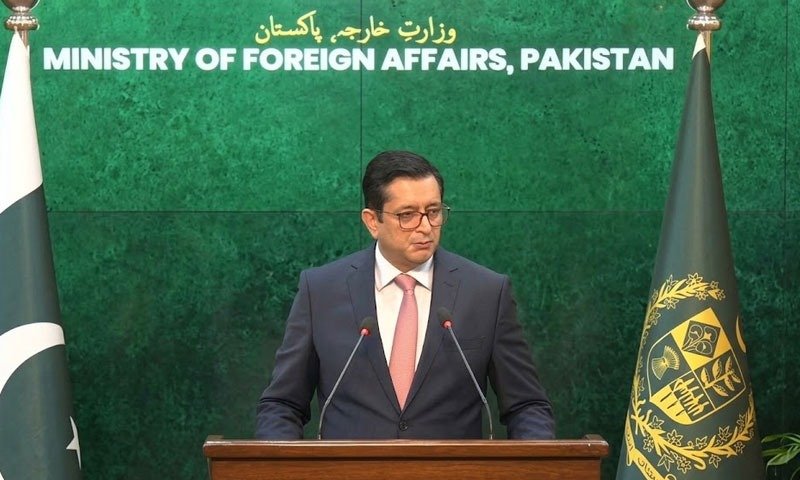
ISLAMABAD: Pakistan on Thursday reaffirmed that it would comply with all applicable sanctions regimes concerning Iran while continuing efforts to facilitate communication between Washington and Tehran.
Foreign Office spokesperson Sajjad Haider Khan said Pakistan would adhere to international and domestic laws on sanctions and remain committed to its role as a mediator between the United States and Iran.
The clarification followed an earlier Foreign Office briefing on September 17, in which Pakistan said it had taken note of new US measures concerning Iranian airlines, including Mahan Air, and was examining their implications with relevant stakeholders.
The Foreign Office had also said the potential impact of the US measures on Pakistan-Iran trade was being evaluated in coordination with the Ministry of Commerce.
Khan said remarks previously attributed to the Foreign Office on the sanctions issue had been taken out of context and required clarification.
“Pakistan is a responsible member of the international community. It adheres to and shall continue to adhere to all applicable sanctions regimes in accordance with international as well as domestic laws,” he said during the weekly press briefing.
He reaffirmed Pakistan’s commitment to a rules-based international system rooted in multilateralism and international law, adding that Islamabad would maintain constant and constructive communication with relevant stakeholders.
The spokesperson also emphasised Pakistan’s relationship with Washington, saying Islamabad valued its enduring strategic partnership with the United States and remained committed to strengthening diplomatic, economic and security ties.
Pakistan to continue Iran-US mediation
Khan said Pakistan would continue facilitating communication between Iran and the United States and urge both sides to exercise restraint, resolve outstanding issues through dialogue and diplomacy, and honour their commitments under the Islamabad Memorandum of Understanding.
He said Pakistan believed dialogue remained the viable path towards a peaceful resolution of the conflict and the broader interests of global peace and security.
Pakistan rejects India’s interpretation of IWT award
The Foreign Office spokesperson also rejected India’s characterisation of the Court of Arbitration’s recent award concerning the Indus Waters Treaty (IWT).
Khan said Pakistan rejected what he described as India’s attempt to create confusion about the award, maintaining that the court had unanimously affirmed that the treaty remained in force and binding on both countries.
He said the court had also ruled that India must observe its treaty obligations concerning the design and operation of hydroelectric projects on the western rivers.
According to Khan, the court had imposed measures restricting concreting work on the dam walls and power intake structures of India’s Ratle hydroelectric project above specified levels until 90 days after the neutral expert’s final decision, which he said was expected around July 2027.
He added that the court had also imposed a reporting requirement on India concerning the Ratle project.
Khan said the Court of Arbitration was constituted under the IWT at the Permanent Court of Arbitration in The Hague. He noted that the court had determined its competence and constitution in a July 2023 award and rejected India’s objections.
He said the court had subsequently reaffirmed its competence following India’s unilateral announcement regarding the treaty’s status, adding that its August 31, 2026, award had rejected India’s claims.
“India cannot escape from the binding awards of the Court of Arbitration through unilateral pronouncements or smokescreening its disregard for the binding treaty obligations,” Khan said.
Pakistan condemns action against Shahi Masjid
The Foreign Office also condemned what it described as arbitrary action and attempts to demolish portions of the historic Shahi Masjid in India’s Madhya Pradesh state, as well as the reported use of force against Muslims protesting the attempted demolition.
Khan expressed concern over what Pakistan described as a wider pattern of actions affecting Muslim places of worship and religious and cultural heritage in India.
He called on the international community to take notice of the situation and urged Indian authorities to protect minorities, their places of worship and fundamental religious freedoms.
Three Pakistanis among five crew members killed off Somalia
Earlier in the briefing, Khan expressed grief over the deaths of five crew members during a recovery operation involving the hijacked vessel MT ALNAOUQ 25 off the coast of Somalia.
Three of those killed were Pakistani nationals: Rafiullah Khan, Syed Kashif Umar and Mahmood Ahmad Ansari.
Four crew members, including three Pakistanis, were injured and were receiving medical treatment, he said.
The surviving crew members were initially brought ashore at Bandar Beyla and later taken to Garowe, where the injured were being treated.
Khan said the Pakistani government remained in contact with Somali authorities and other stakeholders to facilitate medical care for the injured, repatriation of the deceased and the safe return of surviving Pakistani crew members.
He extended condolences to the bereaved families on behalf of the government and people of Pakistan.
India-Pakistan contact at SCO meeting
Responding to a question about a gesture by India’s national coordinator during an SCO meeting in Islamabad, Khan said senior Indian officials had not visited Pakistan for more than two years.
He described the visit as a welcome step and said the Indian official had expressed interest in visiting other Pakistani cities, including Sialkot, Faisalabad and Lahore.
Khan said the presence of the Indian national coordinator reflected shared objectives among SCO member states concerning peace, development, connectivity, trade and transit.
He expressed hope that other events scheduled in Islamabad over the coming year would continue to attract participation from countries across the region.
Dar holds diplomatic meetings
The spokesperson also outlined Deputy Prime Minister and Foreign Minister Ishaq Dar’s recent diplomatic engagements.
Khan said Dar met Turkish Ambassador Irfan Neziroglu on September 18, with discussions focusing on regional developments and progress under bilateral institutional mechanisms.
Dar also met British High Commissioner Jane Marriott to discuss Pakistan-UK relations, understandings reached during his recent visit to the United Kingdom and ways to strengthen bilateral cooperation, including the transformation of coastal Sindh.
The spokesperson highlighted the Sindh Coastal Resilience Project, describing it as a new area of cooperation with the International Fund for Agricultural Development.
He said the project would address climate vulnerabilities in Sindh’s coastal districts, with support from the Asian Development Bank and the Green Climate Fund.
Khan said implementation would require coordination among provincial departments and partner organisations, with an emphasis on transparency, accountability and ensuring that investments deliver tangible benefits for local communities.