Most theses end up on a shelf.
This one refused to stay there.
It began in a quiet university office in Islamabad, where a young graduate student, Muhammad Nasir Butt, placed a thick stack of pages on the desk of his supervisor, Dr. Syed Asad Ali Shah. The two had spent months debating the anatomy of fake news — why people fall for it, how political actors weaponize it, and why the digital age had turned every ordinary citizen into a vulnerable target.
When Dr. Shah began reading the thesis draft, he paused more than once. The work was crisp, original, and disturbingly relevant. It wasn’t just academic; it was actionable. It mapped the infrastructure of misinformation in Pakistan with the precision of someone who had spent years tracing every digital footprint.
When he looked up, he said something many students dream of hearing:
“Nasir, this shouldn’t end as a thesis. This should become an institution.”
Nasir didn’t smile. He took a deep breath — the kind people take when they realize their life might be about to change.
A Project That Turned Into a Mission
In October 2024, long after most theses disappear into archives, the two quietly launched a small initiative they called Fake News Watchdog (FNW).
There was no fancy office.
No donor funding.
No marketing rollout.
Just a student and his supervisor, two laptops, a shared conviction, and a plan to build something Pakistan had never seen before: a research-driven, non-partisan, fact-checking institution rooted in academic discipline rather than media sensationalism.
They gave themselves two years to prove the concept. They needed only twenty-four hours.
The Day Everything Changed
FNW’s first incident report — a methodical reconstruction of a controversial national event — went online one morning.
By lunchtime, journalists were quoting it on Twitter.
By evening, TV producers were calling for interviews.
Before midnight, it was on primetime news across the country.
When Nasir opened his phone the next morning, he found hundreds of messages from reporters, researchers, and government officials. Dr. Shah’s inbox wasn’t any quieter.
The two-year quiet-growth plan had collapsed under the weight of immediate public demand.
FNW had arrived.
Enter the Strategist
Amid this unexpected traction, a third figure stepped into the story: Prof. Syed Rehan Hasan, one of Nasir’s senior professors and a long-time mentor to Dr. Shah.
Prof. Hasan looked at FNW the way an engineer looks at a promising machine — with admiration, but also with an eye for structure, sustainability, and long-term clarity. He understood exactly where FNW could go, but he also understood what it would need to endure.
Where Nasir had built the original intellectual spark,
and Dr. Shah had built the operational engine,
Prof. Hasan brought the blueprint for the full institution.
This trio — one student, one supervisor, one senior professor — formed an unusual but deeply complementary leadership triangle.
FNW became not just a project, but a shared mission.
The Year Pakistan Started Quoting a Thesis
Nothing in FNW’s first year followed the usual pace of academia.
Fourteen major reports and white papers were published.
Not in obscure journals, but on the front pages and primetime hours of:
GEO, DAWN, JANG, Dunya, ARY, Express, The News, The Nation, Tribune, 92 News, Samaa, Bol, GNN, Hum News, Public News, and more than two dozen others.
At one point, Pakistan’s largest newsrooms were quoting a Master’s thesis — not because it was academic, but because it was right, and because no one else was doing this work with such discipline.
Collectively, FNW’s work reached nearly 250 million people in Pakistan and around the world.
In a media landscape where attention is currency, FNW became wealthy overnight.
What They Exposed in Just 12 Months
Their reports read like a diary of Pakistan’s turbulent year:
- protests and counter-protests
- manipulated videos and AI-generated rumors
- political disinformation and cross-border propaganda
- staged retreat narratives
- mythical military operations
- food hoaxes, legal distortions, and digital blackouts
- misinformation that sparked fear, anger, and sometimes national confusion
Whether it was the TLP Gaza March, the May 2025 conflict, the Sindoor airstrike claims, the Donkey Meat Hoax, or the long-running Fuel Price Lie, FNW peeled back layers of falsehood until only verifiable truth remained.
Most strikingly, they challenged everyone — government ministries, political parties, activists, foreign media, and even the military establishment when evidence contradicted official claims.
FNW wasn’t loyal to anyone’s narrative. It was loyal to facts.
That neutrality made it trusted.
From Classrooms to Newsrooms to Public Squares
FNW’s influence didn’t stay online.
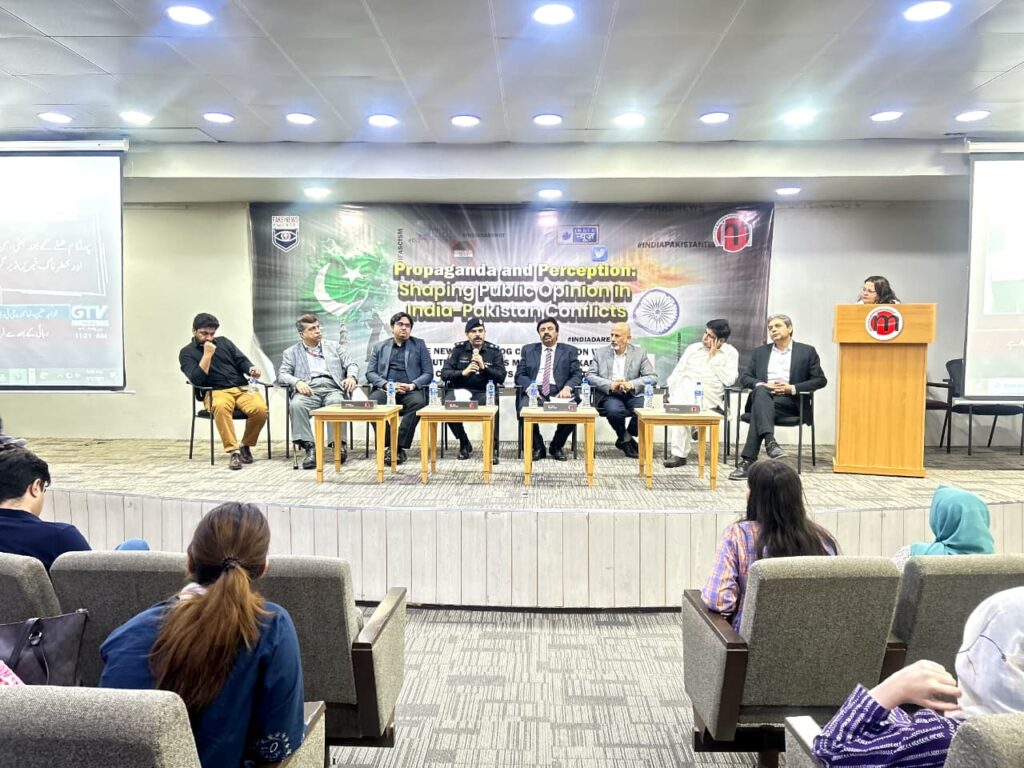
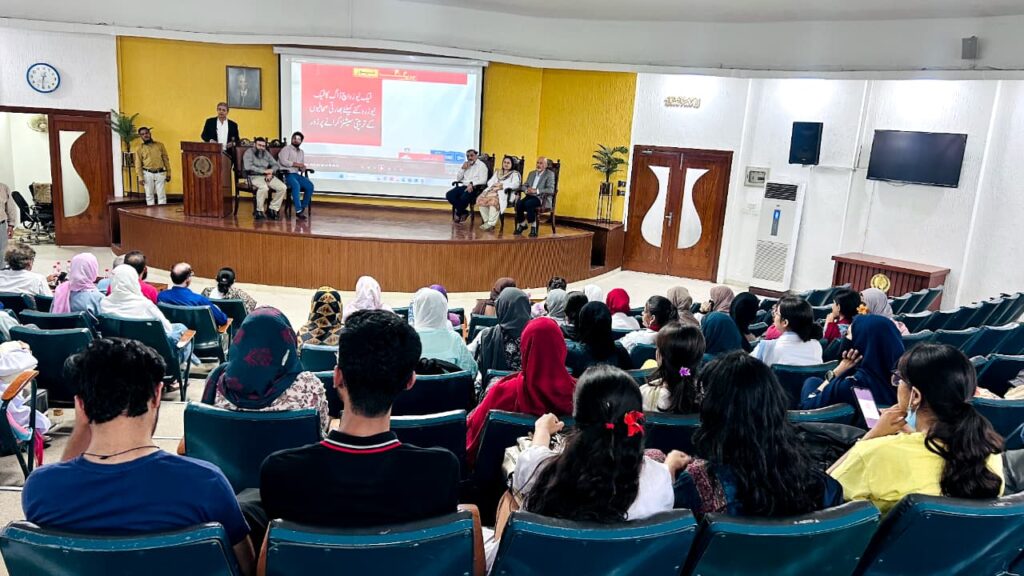
It spilled into universities in Islamabad and Karachi, where hundreds of students sat through FNW’s groundbreaking seminars on:
- misinformation detection
- deepfake verification
- digital ethics
- media literacy
- OSINT investigations
- narrative warfare
Students began treating FNW not as an external organization, but as proof that research can change societies.
Faculty members described the sessions as the missing bridge between academia and journalism.
A Rare Story of Shared Credit
In a professional world where people often fight for credit, FNW’s founders chose the opposite path.
- Nasir is openly acknowledged as the intellectual originator — the student who saw the problem clearly and proposed the nation-scale solution.
- Dr. Shah is recognized for giving the idea structure, method, discipline, and the long hours required to turn scattered insights into national-impact reports.
- Prof. Hasan is celebrated as the strategist who stabilized FNW’s growth, sharpened its institutional presence, and helped elevate it from a project to a sustainable public service model.
FNW is not the story of a single founder.
It is the story of co-authorship, of shared labour, of three minds building something larger than themselves.
Where the Story Goes Next
Today, FNW stands as a model many newsrooms quietly emulate.
Some have adopted its verification frameworks. Others use its timelines when reconstructing chaotic news cycles. Many wait for FNW’s reports before finalizing their own stories.
And now, as FNW enters its second year, its founders are expanding the work — from national monitoring to international collaborations, from incident reports to media forensics, from university seminars to digital public education.
If the first year proved anything, it’s this:
A student’s thesis can change the country — if the right mentors believe in it.
FNW is not just an organization. It is a reminder that truth can still be defended, that academia can still lead from the front, and that intellectual partnerships — when built on trust, humility, and shared purpose — can reshape the national conversation.
On its first birthday, FNW stands exactly where no one expected it to be:
in the headlines, in the classrooms, in the public debate,
and firmly in the future of Pakistan’s information landscape.