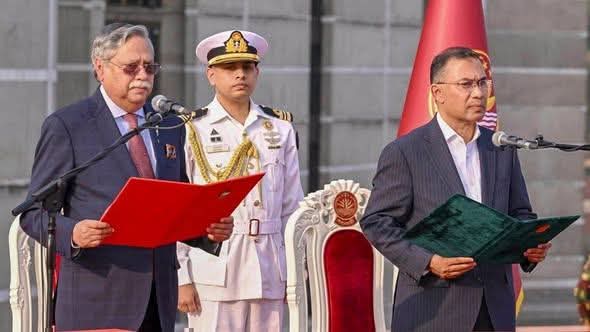
Bangladesh has entered a new and uncertain phase of its political journey, only days after delivering a decisive electoral mandate. The Bangladesh Nationalist Party (BNP), led by Tarique Rahman, secured a two-thirds majority in the February 12 general elections — a result that was widely expected to bring stability after the 2024 mass uprising that ended the long rule of the Awami League. Instead, the country now faces a deep constitutional and political standoff over the implementation of the reform mandate approved through the July National Charter referendum.
The immediate trigger came on February 17, when more than two hundred BNP lawmakers took oath as members of parliament. Within hours, senior party leaders announced that their members would not take oath as part of the proposed Constitutional Reform Council (CRC), the transitional body envisioned to operate for the first 180 days of the new parliament and oversee structural changes to the constitution. The BNP’s position is based on a legal argument: the existing constitution contains no provision for such a council. However, this has opened a wider debate in Dhaka’s legal and political circles, because the recent transitional arrangement under which elections were held also functioned outside the strict framework of the amended constitution. The confrontation has therefore evolved into a fundamental question of legitimacy — whether the will expressed through a referendum can override constitutional technicalities, or whether reform must remain confined within the existing legal order.
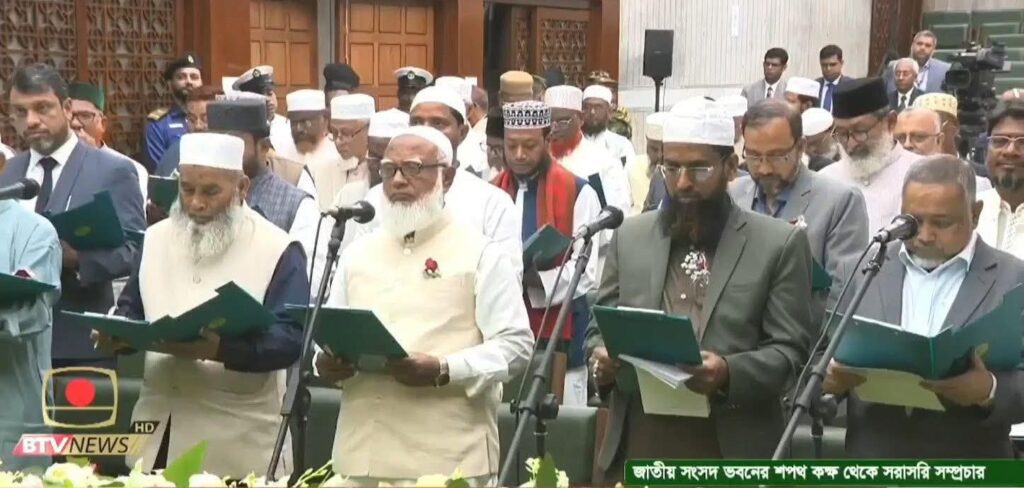
The referendum itself was one of the most significant outcomes of the post-uprising political process. More than seventy percent of voters supported the July Charter, which proposes far-reaching reforms: a two-term limit for the prime minister, the creation of an upper house, enhanced judicial independence, expansion of fundamental rights, and structural checks on executive authority. The political logic behind these proposals was to prevent the re-emergence of a highly centralised system of power that had come to define the previous era. For many of the young people who led the 2024 movement, these reforms are not technical adjustments but the core promise of the revolution. Their frustration has already begun to surface, with student groups and the National Citizen Party describing the refusal to join the reform council as a betrayal of the uprising’s spirit. Dhaka University — historically the epicentre of every major political movement in the country — is once again being closely watched for signs of mobilisation.
Bangladesh’s constitutional history suggests that such confrontations are not new. Since independence in 1971, the country has repeatedly shifted between different governance models — from parliamentary democracy to one-party presidential rule in 1975, through periods of military intervention, to the restoration of parliamentary politics in the 1990s. Major political transitions have rarely followed a smooth legal path; instead, they have been resolved through political confrontation followed by constitutional accommodation. The current standoff reflects the same pattern, with three competing sources of legitimacy now in play: the parliamentary supermajority, the referendum mandate, and the existing constitutional framework.
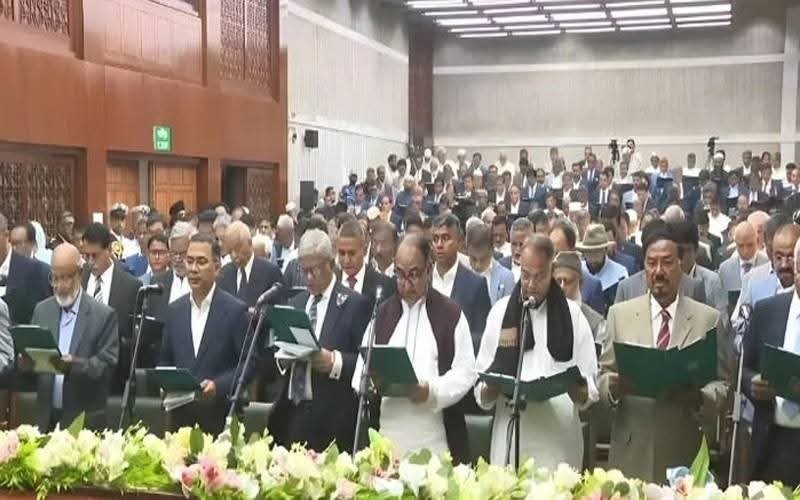
Behind the legal debate lies a deeper political calculation. The July Charter’s reforms would directly limit the authority of a government that currently enjoys an overwhelming parliamentary majority, particularly by introducing term limits and institutional checks. BNP supporters argue that the referendum itself was constitutionally questionable because earlier amendments removed the provision for such votes. Critics counter that ignoring a reform package endorsed by a clear majority of voters would amount to rejecting popular sovereignty. This clash between electoral power and reform commitments has turned what should have been a moment of consolidation into a potential crisis.
The stakes are higher because the confrontation is unfolding in the middle of a severe economic slowdown. Inflation remains above eight percent, food prices continue to rise, the banking sector is burdened with an exceptionally high level of non-performing loans, and the country is approaching the end of its duty-free trade privileges in key export markets. The ready-made garments sector, which accounts for roughly four-fifths of Bangladesh’s export earnings, faces a period of uncertainty. At the same time, energy shortages — particularly the gas crisis affecting urban households — are already fuelling public frustration. Any prolonged political instability could damage investor confidence and complicate efforts to negotiate new trade arrangements.
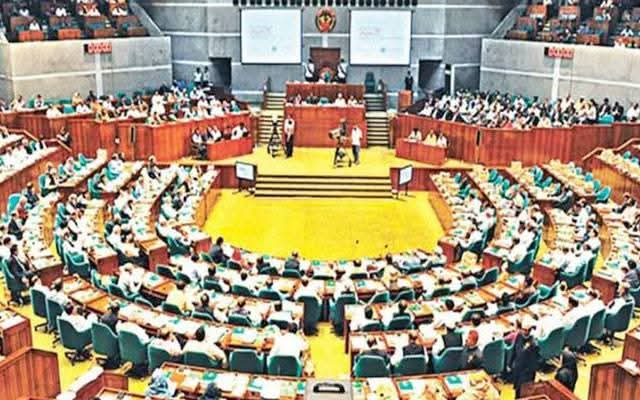
Prime Minister Tarique Rahman has announced a 49-member cabinet, a move that his supporters describe as an attempt to accommodate different political factions and ensure stability. Critics, however, see it as an early sign of a return to patronage-based governance at a time when fiscal discipline is urgently needed. The central question remains whether the government will use its supermajority to implement the reform mandate or to reshape the constitutional order in a way that preserves executive dominance.
The absence of the Awami League from parliament and Sheikh Hasina’s continued stay in India have already transformed the country’s political landscape and its regional dynamics. For the first time in years, Bangladesh has a legislature without the party that dominated its politics for more than a decade and a half. Yet the promise of a more competitive and participatory parliamentary system now depends on whether the new political leadership can reconcile the demands of institutional reform with the realities of power.
The coming weeks are likely to be decisive. Ramadan has historically been a period when rising prices trigger public anger, and any disruption in the supply of essential commodities or energy could quickly translate into street protests. Bangladesh therefore stands at a critical juncture: one path leads to a negotiated constitutional transformation that fulfils the aspirations of the 2024 uprising, while the other risks returning the country to the familiar cycle of confrontation between elected authority and popular mobilisation.
For Tarique Rahman, the election represents personal political redemption after years in exile. For Bangladesh, it is a test of whether a supermajority can coexist with a reform mandate without repeating the centralisation of power that provoked the last upheaval. The direction chosen in the next few months will determine not only the fate of the current government but the shape of the post-Hasina political order and the credibility of Bangladesh’s democratic transition.