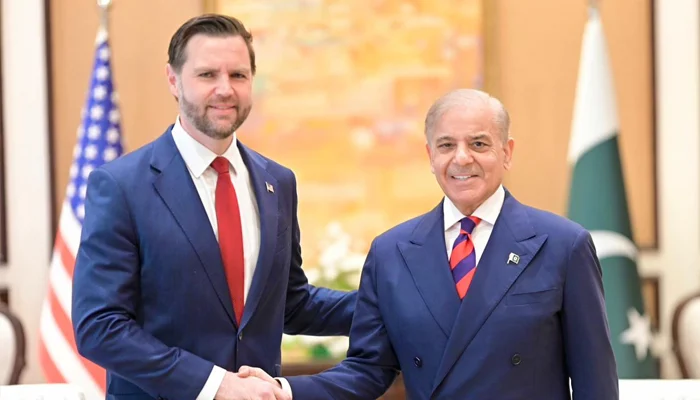
ISLAMABAD: Prime Minister Shehbaz Sharif on Saturday met United States Vice President JD Vance as the much-anticipated Islamabad Talks formally commenced, expressing hope that the negotiations would lead to durable peace in the Middle East.
The US vice president JD Vance was accompanied by Special Envoy Steve Witkoff and Jared Kushner, while the prime minister was joined by Deputy Prime Minister and Foreign Minister Ishaq Dar and Interior Minister Mohsin Naqvi.
Commending both delegations for their constructive engagement, the premier said Pakistan remained committed to facilitating dialogue and progress towards sustainable peace. He added that Islamabad would continue to support efforts aimed at bridging differences between Washington and Tehran.
The meeting followed the arrival of a high-level US delegation led by Vance, while an Iranian team headed by Mohammad Baqer Qalibaf also reached Islamabad ahead of the talks. Iran’s Foreign Minister Abbas Araghchi is expected to play a key role in negotiations.
The talks come in the wake of a two-week ceasefire announced by Donald Trump after weeks of intense conflict involving US and Israeli strikes on Iran. Despite the truce, tensions remain elevated, particularly over the Strait of Hormuz and ongoing hostilities in Lebanon.
During initial engagements, Qalibaf stressed that progress would depend on Washington fulfilling prior commitments, including easing restrictions on Iranian assets and ensuring a ceasefire in Lebanon. Meanwhile, Vance expressed cautious optimism but warned of a firm response to any attempt to derail the process.
The conflict, which erupted on February 28 following coordinated strikes on Iran’s leadership and infrastructure, has resulted in thousands of casualties and widespread instability across the region. Tehran’s retaliatory actions included disruptions to shipping through the Strait of Hormuz and attacks on US and Israeli interests.
A ceasefire was eventually secured on April 8, with Pakistan playing a central mediating role. However, key disagreements persist as both sides enter negotiations with competing frameworks.
At the core of the talks are disputes over Iran’s nuclear programme, with the US seeking strict limits and monitoring, while Iran insists on its right to peaceful nuclear activity. Sanctions relief remains another major sticking point, as Tehran demands immediate removal of restrictions, whereas Washington favours a phased approach tied to compliance.
Control of the Strait of Hormuz is also under discussion, with Iran seeking recognition of its regulatory role, while the US insists on unrestricted international access due to the waterway’s global energy importance.
Other contentious issues include Iran’s ballistic missile programme, regional influence, the presence of US forces in the Middle East, and demands for accountability and compensation arising from recent hostilities.
The international community has broadly welcomed Pakistan’s diplomatic efforts, viewing the Islamabad Talks as a critical opportunity to de-escalate tensions and lay the groundwork for a comprehensive and lasting peace agreement.