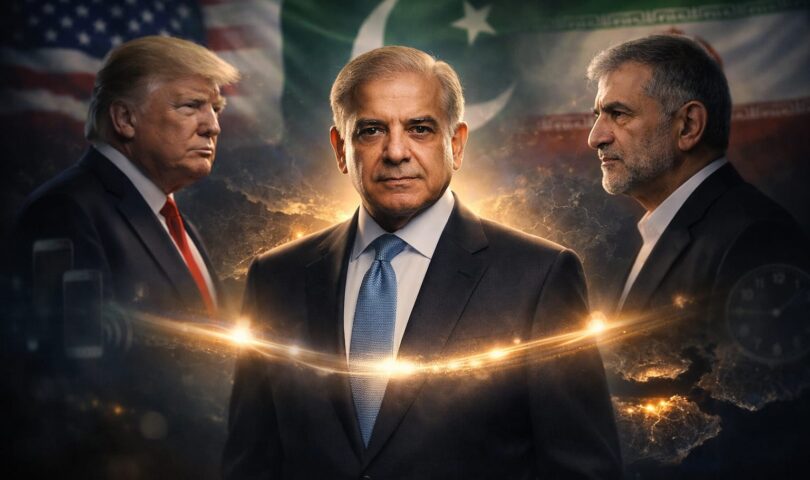
At a moment when the world stood on the edge of yet another devastating war, Pakistan did what few nations could it stepped in quietly, decisively, and effectively to pull the region back from the brink.
Less than two hours before a looming American deadline that threatened to unleash unprecedented destruction on Iran, Pakistan brokered a critical two-week ceasefire. This was not just a diplomatic success; it was a strategic intervention that prevented a potential regional apocalypse.
Unlike traditional diplomacy dominated by public summits, press conferences, and prolonged negotiations, Pakistan’s approach was different calculated, discreet, and fast-moving. This was classic backchannel diplomacy at its finest.
A New Face of Pakistani Statecraft
At the center of this breakthrough stood Field Marshal Syed Asim Munir, whose direct engagement with both Washington and Tehran proved pivotal. His real-time communication and crisis management ensured that channels remained open when formal diplomacy had nearly collapsed.
Prime Minister Shehbaz Sharif provided the political leadership and credibility required to carry this sensitive engagement forward, while Deputy Prime Minister and Foreign Minister Ishaq Dar ensured that key regional stakeholders including Türkiye, Saudi Arabia, and Egypt were aligned behind the effort.
This coordinated statecraft reflects a maturing Pakistan one that is no longer reactive, but proactive in shaping regional stability.
Trust: Pakistan’s Greatest Strategic Asset
What made Pakistan uniquely capable of playing this role was not coincidence, but credibility built over years.
Pakistan remains one of the few countries that maintains working relationships with both the United States and Iran two adversaries deeply entrenched in geopolitical rivalry. This rare position gave Islamabad the leverage needed to mediate when others could not.
Trust painstakingly developed through consistent diplomacy became Pakistan’s most powerful tool.
And when the moment came, that trust translated into influence.
Diplomacy in the Digital Age
One of the most fascinating aspects of this breakthrough was the method itself.
Instead of formal negotiation tables, Pakistan utilized encrypted communication channels WhatsApp and Signal to conduct rapid, discreet, and deniable exchanges between stakeholders. This modern adaptation of shuttle diplomacy allowed decisions to be made in hours, not weeks.
In an era where speed can determine the difference between war and peace, Pakistan demonstrated a model of agile diplomacy that many global powers are yet to master.
Global Recognition and Regional Discomfort
Pakistan’s role has not gone unnoticed.
Leaders from across the world from Europe to Asia have acknowledged Islamabad’s contribution to de-escalation. Calls for international recognition, even suggestions of a Nobel Peace Prize, reflect the scale of this diplomatic success.
However, not everyone is comfortable.
India’s cautious and somewhat reluctant response highlights a shifting regional reality Pakistan is emerging not just as a security actor, but as a credible diplomatic power.
Islamabad: The New Diplomatic Hub
The upcoming talks between the United States and Iran, scheduled in Islamabad, mark a significant geopolitical shift.
For decades, global negotiations have been hosted in Western capitals or neutral European venues. Today, Islamabad is positioning itself as a center of high-stakes diplomacy.
This is not symbolic it is strategic.
Pakistan is transitioning from being a participant in global affairs to becoming a platform where global decisions are shaped.
Beyond the Ceasefire
While the two-week ceasefire is a critical first step, the real challenge lies ahead.
Sustainable peace will require complex negotiations, difficult compromises, and continued engagement. Yet, the fact that both Washington and Tehran are willing to sit across the table is itself a major achievement one made possible by Pakistan.
This moment underscores a larger truth:
Pakistan is no longer on the sidelines of global geopolitics.
It is at the center.
Conclusion: A Defining Moment for Pakistan
In a world increasingly defined by conflict, Pakistan has demonstrated the power of diplomacy, restraint, and strategic foresight.
This is more than a temporary ceasefire it is a statement.
A statement that Pakistan can lead.
A statement that Pakistan can mediate.
A statement that Pakistan can prevent wars not just fight them.
And perhaps most importantly, a statement that the future of regional stability may very well pass through Islamabad.