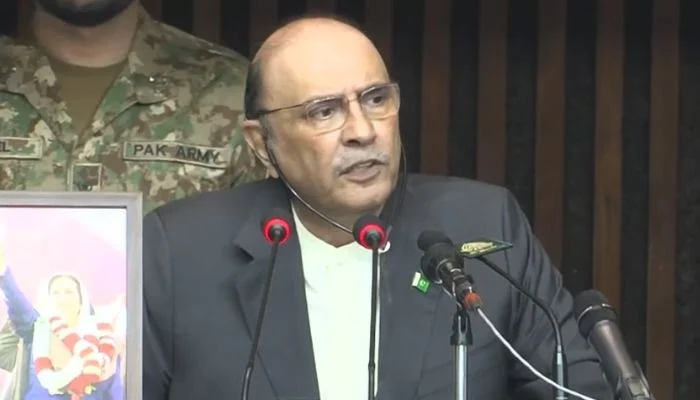
ISLAMABAD: President Asif Ali Zardari on Monday termed war a last resort and urged India to shift from battlefields to meaningful negotiations, warning that any aggression would be met with a decisive response.
“Make no mistake. We are ready for you,” the president said in his annual address to a joint sitting of parliament at the start of the new parliamentary year.
“My message is to move away from war theatres to meaningful negotiating tables because that is the only path for regional security,” he said, adding that Pakistan would continue to extend its fullest diplomatic and moral support to the people of Jammu and Kashmir.
The session, co-chaired by Senate Chairman Syed Yousuf Raza Gilani and National Assembly Speaker Sardar Ayaz Sadiq, was attended by Prime Minister Shehbaz Sharif, members of both houses, provincial governors, chief ministers and diplomats. Opposition lawmakers staged a protest during the address, chanting slogans against the president.
In his speech, the president discussed national, regional and international issues, including Kashmir, Palestine, tensions in the Gulf region, Marka-e-Haq and Operation Ghazab lil-Haq, the Indus Waters Treaty, economic reforms and provincial autonomy.
He said peace in South Asia would remain elusive until Kashmiris achieved their right to self-determination.
Middle East crisis
Condemning the war against Iran, President Zardari reaffirmed Pakistan’s support for Iran’s sovereignty and territorial integrity and expressed condolences over the martyrdom of Supreme Leader Ayatollah Ali Khamenei.
He also condemned subsequent attacks on Saudi Arabia, United Arab Emirates, Bahrain, Jordan, Kuwait and Qatar, urging restraint and respect for international law.
“The sooner stability returns to the region, the sooner the world can rebuild lives and fractured trust,” he said.
Security and counterterrorism
Referring to Marka-e-Haq, he said Pakistan initially exercised restraint in the face of Indian violations but later responded with professionalism, turning aggression into a strategic victory.
He also mentioned the February 26 attacks by the Afghan Taliban regime, saying Pakistan’s armed forces acted decisively. He thanked the army, air force, navy, Rangers, Frontier Corps, police and intelligence agencies for their coordinated response.
While visiting the families of martyred soldiers, he said he felt the same pain as during the martyrdom of his wife, Benazir Bhutto.
“This was not just a military victory; it was an expression of our national resolve,” he said, adding that Pakistan’s response was acknowledged by world capitals.
Deliberating on Operation Ghazab lil-Haq, the president said Pakistan had exhausted diplomatic channels before responding to cross-border terrorism from Afghanistan.
“For us, war is always the last option. We have let both India and Afghanistan see a fraction of our capabilities,” he remarked, warning that Pakistan would not allow any entity to use neighbouring soil to destabilise its peace.
He accused the Afghan Taliban regime of providing sanctuaries to terrorist groups including Al-Qaeda, BLA and TTP, in violation of commitments made in Doha.
Foreign policy and global ties
On Pakistan-United States relations, he appreciated efforts to de-escalate tensions and said both countries had opened new avenues of cooperation over the past year.
He said Pakistan’s relationship with China had reached new heights and expressed gratitude to President Xi Jinping for supporting shared objectives of security and connectivity, especially under CPEC 2.0.
He also welcomed stronger ties with Gulf states, Azerbaijan and Turkiye, terming the Pakistan-Saudi Strategic Mutual Defence Agreement a milestone.
Reiterating support for Palestine, he called for the creation of an independent state with pre-1967 borders and Al-Quds Al Sharif as its capital.
Indus Waters Treaty and economy
The president criticised India’s unilateral actions regarding the Indus Waters Treaty, terming them “hydro-terrorism” that endangered Pakistan’s agricultural economy and violated international law.
He vowed that Pakistan would defend its water rights with unity and legal clarity.
On domestic matters, President Zardari stressed the importance of provincial autonomy, effective functioning of constitutional forums and a just National Finance Commission Award.
Highlighting Balochistan, he said genuine grievances of the Baloch people were being addressed alongside efforts to counter insurgency.
He commended the government for steering the economy away from collapse but emphasised the need for inclusive growth, tax reforms, energy restructuring and climate-resilient agriculture.
He also called for strengthening the Benazir Income Support Programme to empower the poor and urged greater protection and economic inclusion of women.
Recalling the vision of Muhammad Ali Jinnah and the legacy of Zulfikar Ali Bhutto, he noted that through the 18th Amendment, presidential powers were returned to parliament, reinforcing democratic governance.
“With the start of the new parliamentary year, our priorities must be to protect sovereignty, eliminate terrorism and build on economic stability,” President Zardari said, urging unity and reform to ensure that macroeconomic gains translate into relief for the common citizen.