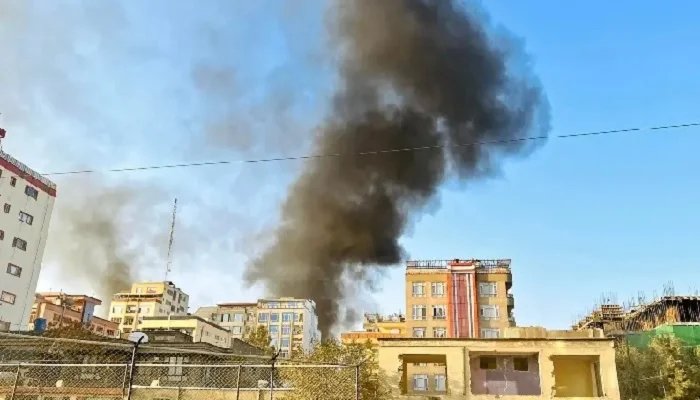
ISLAMABAD: Pakistan carried out intelligence-based strikes targeting seven terrorist camps and hideouts belonging to Fitna al Khawarij (FAK), its affiliates and Daesh-Khorasan along the Pakistan-Afghanistan border in response to recent suicide attacks, the government said early Sunday.
According to the Ministry of Information, the operation was conducted with precision as a retributive response to suicide bombing incidents in Islamabad, Bajaur and Bannu during the holy month of Ramadan.
“The suicide attacks were carried out by khawarij on the direction of Afghanistan-based leadership and handlers,” the ministry said, adding that responsibility was also claimed by Afghanistan-based Tehreek-e-Taliban Pakistan linked to FAK and Daesh.
Despite repeated requests urging Afghan authorities to take verifiable measures to prevent the use of their territory by terrorist groups and foreign proxies, no substantive action was taken, the statement added. Pakistan, it said, remains committed to regional peace but prioritises the safety and security of its citizens.
The government called on the interim Afghan administration to fulfil its obligations and prevent Afghan soil from being used against Pakistan. It also urged the international community to encourage Kabul to honour commitments under the Doha Agreement to ensure regional and global peace.
Sources said an explosion targeted a militant hideout in the Barmal area of Afghanistan’s Paktika province, where jet aircraft carried out an airstrike destroying militant infrastructure. Additional strikes were reported in Khogyani district of Nangarhar province, as well as in Ghani Khel, Behsud and Argoon areas. Afghan media reported that the number of possible militant casualties could not be confirmed.
The airstrikes came hours after security forces gunned down five terrorists belonging to Fitna al-Khawarij during an intelligence-based operation in Bannu district, the military said.
According to the Inter-Services Public Relations (ISPR), the operation was launched after reports of terrorist presence, including a suicide bomber. A vehicle-borne suicide bomber was intercepted by the leading group, foiling a planned attack on civilians and law enforcement personnel in Bannu city.
During an intense exchange of fire, five militants were killed. In a retaliatory act, terrorists rammed an explosive-laden vehicle into a security forces vehicle. As a result, Lt Colonel Shahzada Gul Faraz, 43, a resident of Mansehra, and Sepoy Karamat Shah, 28, from Peshawar, embraced martyrdom.
The ISPR said Pakistan will not exercise restraint and operations will continue against perpetrators of terrorist acts irrespective of their location.
Meanwhile, Federal Minister for Parliamentary Affairs Tariq Fazal Chaudhry said in a post on X that those conspiring against Pakistan had received a clear message, adding that the timely action of the Pakistan Air Force targeted militant hideouts operating under foreign patronage.
Pakistan’s latest strikes come amid strained ties with Kabul. Defence Minister Khawaja Asif recently warned that Islamabad would not hesitate to conduct further strikes unless credible assurances of peace were provided.
Since the Taliban regained control of Afghanistan in 2021, Pakistan has witnessed a rise in cross-border militant activity, particularly in Khyber Pakhtunkhwa and Balochistan.
In a press briefing on January 6, ISPR Director General Ahmed Sharif Chaudhry said law enforcement agencies carried out 75,175 intelligence-based operations nationwide in 2025. Of these, 14,658 were conducted in KP, 58,778 in Balochistan and 1,739 in other parts of the country.
He said 5,397 terrorist incidents were recorded nationwide last year, with 3,811 in KP, 1,557 in Balochistan and 29 elsewhere. Counterterrorism operations resulted in the elimination of 2,597 terrorists, he added, noting that 10 major attacks targeting civilians involved militants operating from Afghanistan.