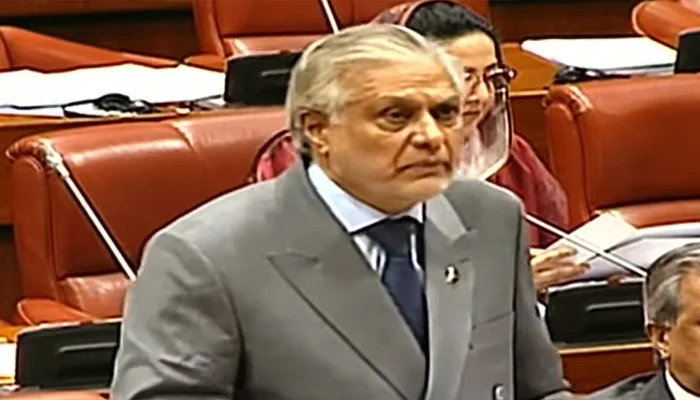
ISLAMABAD: Deputy Prime Minister and Foreign Minister Ishaq Dar on Tuesday told the Senate that Iran had agreed not to acquire nuclear weapons, while the United States was seeking the complete dismantling of Tehran’s nuclear programme.
“I held a meeting with US Secretary of State Marco Rubio and disclosed that Iran had agreed not to build nuclear weapons, but the US wanted Iran’s entire nuclear programme to be completely dismantled,” he said while briefing the upper house on Pakistan’s diplomatic efforts following the recent attack on Iran.
The Middle East conflict has expanded with no clear end in sight, as Israel attacked Iran and Tehran responded with missiles and drones targeting US interests and bases across the Gulf states.
During the four-day conflict, several senior Iranian leaders, including Supreme Leader Ayatollah Ali Khamenei, were martyred in what Dar described as “unprovoked and unwarranted” airstrikes by Israel and the United States.
Iranian officials warned that Khamenei’s martyrdom would mark a turning point, with the Revolutionary Guard vowing retaliation and declaring that the “great crime will not go unpunished”.
Speaking on the Senate floor, Dar said Pakistan ensured that Iran’s right to pursue a peaceful nuclear programme was recognised.
He informed lawmakers that Pakistan was prepared to facilitate mediation between the United States and Iran in Islamabad, adding that Prime Minister Shehbaz Sharif and Field Marshal Asim Munir played a “very active and positive role” in diplomatic and defence-level engagements.
Dar said he immediately contacted the Iranian foreign minister after the attack and strongly condemned the strikes. He added that the prime minister conveyed condolences on the martyrdom of Ayatollah Khamenei on behalf of the government and people of Pakistan.
He said he had also spoken to the foreign ministers of Turkiye, Maldives, Bangladesh, Uzbekistan, Saudi Arabia, United Arab Emirates, Qatar and Oman.
According to Dar, Oman’s foreign minister informed him that positive progress had been made in Iran-US talks and negotiations were moving in the right direction before the attack occurred.
He reiterated that Iran was a brotherly and neighbouring country and that Pakistan had made full-scale diplomatic efforts, including back-channel engagement, to seek a peaceful resolution. The Iranian leadership, he said, was fully aware of Islamabad’s efforts.
Dar recalled that when Pakistan held the presidency of the UN Security Council, it convened debates on the issue and consistently supported Iran’s right to the peaceful use of nuclear energy.
He said the recent attack resembled last year’s June incident, when the Iranian foreign minister invited Asim Munir to Istanbul during his return journey from the United States via the United Kingdom to discuss resolving tensions through diplomacy.
The deputy premier said Pakistan stood with Iran and emphasised that the country should not be dragged into the conflict, particularly after attacks targeted Gulf states and Iran announced strikes on US bases.
He said Pakistan condemned the attack within 15 minutes despite resistance and pressure, stressing that Islamabad was not seeking “numbers or hype” but fulfilling its diplomatic responsibility.
A decision taken in a meeting chaired by the prime minister was to continue efforts to reduce tensions, he added.
Security assurances and evacuations
Dar informed the Senate that Iran had sought assurances that its territory would not be used against it, and Pakistan conveyed those assurances. He added that Saudi Arabia had also provided similar assurances.
He said comparatively fewer attacks occurred in Saudi Arabia and Oman and that Pakistan facilitated the assurances sought by Iran from Riyadh.
Around 35,000 Pakistanis are currently in Iran, Dar said, adding that the Taftan-Zahedan border remains operational. He informed lawmakers that 792 Pakistanis had been evacuated so far. While airspace remains closed, road routes are open for those returning.
Describing the situation as highly challenging, Dar said the entire region was facing a conflict-like environment and reiterated that the government remained fully engaged diplomatically.