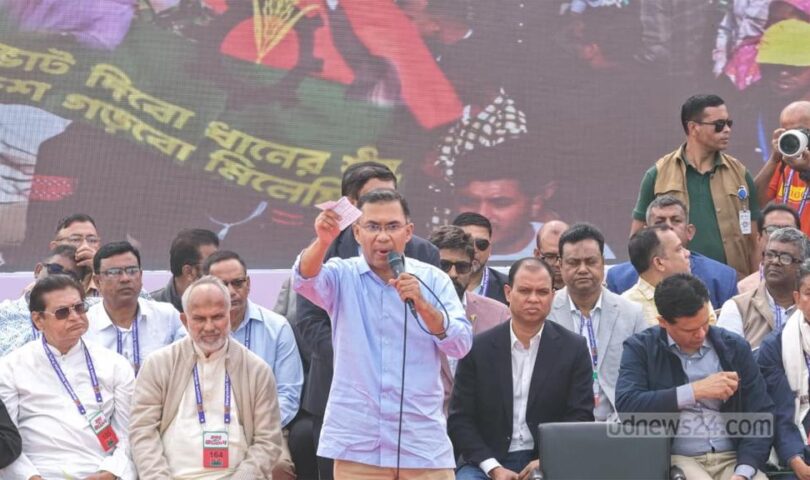
DHAKA: Just weeks after returning to Bangladesh from nearly two decades in London, Tarique Rahman finds himself at the center of one of the country’s most consequential elections.
If current trends hold, the acting chairman of the
Bangladesh Nationalist Party (BNP) could lead his party to victory and become prime minister — following the political path once walked by both his parents.
Rahman, 60, left Bangladesh in 2008 after detention during a military-backed caretaker period and years of political pressure. He returned last Christmas to a hero’s welcome after the 2024 youth-led uprising ended the long rule of the
Awami League under Sheikh Hasina, who now lives in exile in New Delhi.
For many Bangladeshis, this election has become a story of political reversal, generational change, and unfinished history.
A Political Legacy Re-Entering the Stage
Rahman is the son of former prime minister Khaleda Zia and former president Ziaur Rahman, the BNP’s founder and a key figure of Bangladesh’s early political era. Born in Dhaka in 1965, he studied at the University of Dhaka before entering business.
During his mother’s 2001–2006 tenure, Rahman was frequently accused by critics of operating an informal power center — an allegation he has consistently denied.
Since returning, he has carefully recast his public image. Soft-spoken and measured, Rahman now emphasizes reconciliation over confrontation.
“What does revenge bring? What we need is peace and stability,” he said in a recent interaction with international media.
Policy Signals: Balance, Reform, and Investment
Rahman’s campaign messaging focuses on recalibrating Bangladesh’s foreign relations to avoid over-dependence on any one country, encouraging broader investment, and introducing structural political reforms.
Among the ideas he has highlighted:
• A two-term, 10-year limit for prime ministers
• Diversifying the economy beyond garments into sectors like toys and leather
• Expanding financial support for low-income families
• Projecting a balanced international posture
These themes resonate strongly with youth voters calling for systemic change after the events of 2024.
Youth Energy Meets Political Inheritance
On campuses like University of Dhaka, students speak about reform, dignity, and a break from “old politics.” Many say they are not voting for personalities but for a new governance model.
Yet Rahman’s return illustrates how political inheritance and youth energy are intersecting in this election. His daughter Zaima has been visible in outreach efforts, signaling a generational bridge within a legacy party.
Familiar Echoes for Pakistan
For Pakistani observers, Rahman’s trajectory carries familiar notes.
Like Bilawal Bhutto Zardari, Rahman represents the next generation of a powerful political family attempting to redefine itself after years of turbulence. Both men carry the weight of legacy while trying to project a modern, reform-oriented image to younger voters.
Both narratives involve:
• Political heirs stepping forward after long periods shaped by their parents’ dominance
• Youth voters demanding reform over rhetoric
• Efforts to move beyond past rivalries toward stability and institutional change
In Bangladesh, as in Pakistan, the question is whether dynastic leadership can align with a generation demanding systemic transformation.
A Vote About the Future, Not the Past
As Bangladesh heads to the polls, Rahman’s candidacy has come to symbolize more than a party comeback. For many voters, it reflects a chance to reset political norms, limit executive power, and rebalance the country’s external relationships.
Whether that vision translates into votes will be known soon. But on Dhaka’s streets, the conversation is already about what comes after a Bangladesh that feels fairer at home and more confident abroad.