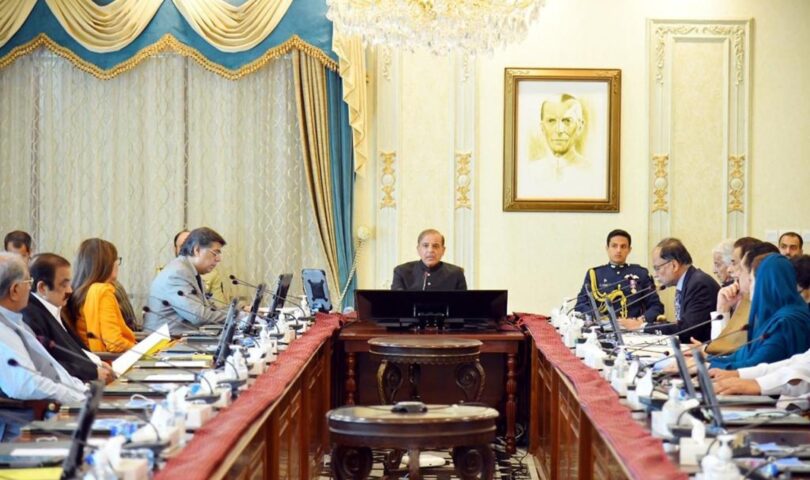
ISLAMABAD — Prime Minister Shehbaz Sharif chaired a meeting of the Federal Cabinet via video link from Baku, during which the cabinet unanimously approved the draft of the 27th Constitutional Amendment. The Prime Minister and cabinet members welcomed the development, appreciating the collective efforts that led to the agreement.
Following the approval, Minister for Law and Justice Azam Nazeer Tarar briefed the media on the key features of the amendment, which will now be presented in Parliament for debate and final approval.
Prime Minister Shehbaz Sharif expressed gratitude to coalition partners for their cooperation, emphasizing that the amendment aims to strengthen the federation’s relationship with the provinces and advance the national interest. He commended the Ministry of Law and Justice, the Attorney General, and their teams for their dedicated work.
“I also took my leader, Mian Muhammad Nawaz Sharif, into confidence on this important amendment and received his valuable guidance, for which I am deeply grateful,” the Prime Minister said. He added that President Asif Ali Zardari had also been consulted and expressed his consent, for which he offered sincere thanks.
The Prime Minister extended appreciation to the heads of allied parties — Bilawal Bhutto Zardari, Dr. Khalid Maqbool Siddiqui, Abdul Aleem Khan, Khalid Hussain Magsi, and Chaudhry Salik Hussain — for their cooperation during consultations. He also acknowledged discussions with Aimal Wali Khan, Ijaz-ul-Haq, and other political leaders.
“By the grace of Almighty Allah, political and economic stability has set the country on the right course. We must continue working together for Pakistan’s progress and prosperity,” he said.
Key Features of the 27th Constitutional Amendment
Minister Azam Nazeer Tarar said consensus has been achieved on establishing a Federal Constitutional Court, fulfilling a long-standing commitment made under the Charter of Democracy. The proposed bill will be tabled in Parliament for detailed debate.
The main provisions of the amendment include:
The Judicial Commission of Pakistan will oversee the transfer of judges to ensure transparency.
Consultations on judicial transfers will involve the Chief Justice of Pakistan and respective High Court Chief Justices.
Simultaneous Senate elections across the country have been proposed to ensure uniformity.
The number of advisers to the Prime Minister may be increased from five to seven.
The representation quota for Sindh and Balochistan in provincial cabinets is proposed to rise from 11% to 13%.
A framework is proposed to grant lifetime national honors for outstanding national heroes.
Newly elected Senators from Khyber Pakhtunkhwa, whose elections were delayed due to legal proceedings, will be deemed to have served from the previous term.
Minister Tarar underscored that the government held extensive consultations with all major political parties, including the PPP, MQM, PML, IPP, BAP, ANP, and NP, to ensure broad political consensus.