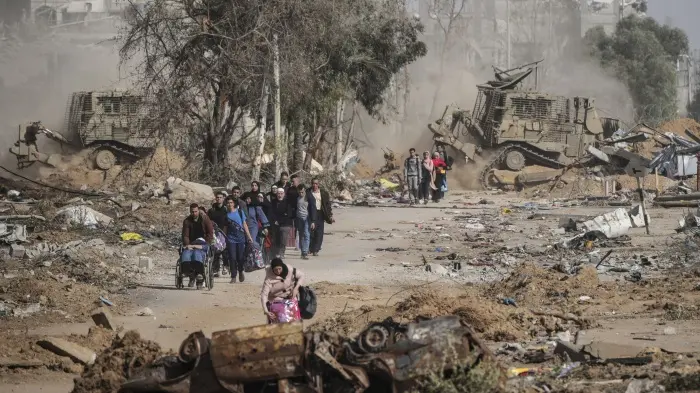
When the Gaza war erupted again in late 2023, the world confronted not only a military conflict but a new information battlefield. For decades, Palestinian suffering existed in the margins of global media — partially seen, selectively told, often overshadowed by official narratives and geopolitical interests. But from 2023 to the fragile ceasefire of late 2025, something profoundly different happened: ordinary Palestinians, armed only with phones and unstable internet connections, rewrote how the world witnessed the war.
This was not merely a communications shift. It was the first fully networked, crowd-documented Gaza war, where livestreams replaced press briefings, where a teenager with a dying battery shaped global empathy more than any foreign correspondent, and where attempts to suppress or distort content triggered global backlash instead of silence.
This is the story of how digital witnessing changed the world’s understanding of Gaza — and what it means for journalism, politics, and accountability.
A war the world saw from the inside
For the first time in Gaza’s long history of conflict, the early days of the 2023–2024 bombardments were documented not primarily by news crews — most of whom were blocked or barred — but by Palestinians themselves.
Citizen journalists, paramedics, teachers, mothers, teenagers: all became frontline documentarians.
Images of collapsed apartment blocks, starving families in makeshift tents, hospitals out of service, and children pulled from rubble appeared in real time, before governments had issued statements and before most major outlets had verified casualty numbers.
This inversion of narrative power mattered deeply:
- Palestinians no longer appeared only as statistics but as living witnesses narrating their own trauma.
- Unfiltered footage undermined official narratives that portrayed the assault as “precise” or “limited”.
- Journalistic verification shifted — instead of waiting for reporters, editors were verifying the work of the people being bombed.
In these moments, Gaza’s civilians — long spoken about — became agents of global storytelling.
The rise of digital “war correspondents” without newsrooms
Within months, previously unknown Palestinians became globally recognised chroniclers of Gaza’s devastation. Their updates shaped diplomatic debates, fueled protests from Jakarta to New York, and forced traditional media into a reactive mode.
The most striking qualities of this cohort were:
1. Radical Proximity
They were not observing the war — they were inside it. Their videos were shaky, breathless, unedited, often filmed moments after an explosion. Authenticity replaced production value.
2. Personal Narratives over Abstractions
Instead of casualty figures, they spoke of lost neighbours, collapsed schools, and hunger stalking entire districts. Personal stories replaced sterile terminology like “collateral damage”.
3. Journalism as Survival, Not Profession
Their updates served dual purposes:
- to inform the world,
- and to signal that they were still alive.
This duality created an emotional connection that traditional journalism rarely achieves without compromising neutrality.
The struggle to be seen: algorithms, censorship, and the politics of visibility
As Palestinian visibility surged, so did concerns about algorithmic suppression.
Content documenting bombings or injured civilians was often flagged as “graphic,” “hate speech,” or “misinformation.” Videos disappeared without explanation, hashtags were restricted, and accounts were suspended despite their material being essential record of war.
For Palestinians, this felt like a digital extension of the physical siege:
- Their land was blockaded.
- Their movement was restricted.
- And now their voices were being throttled by opaque moderation systems controlled abroad.
Tech companies insisted they were enforcing safety rules. Yet many critics argued these systems systematically privileged state narratives and disproportionately penalized documentation of Palestinian suffering.
The consequence was chilling:
Platforms meant to democratise storytelling became arenas where visibility itself was a casualty.
And yet — Palestinians persisted. They posted through VPNs, backups, duplicate accounts, cloud folders, offline sharing networks, Bluetooth exchanges. Their determination to be seen kept the world’s attention fixed on Gaza despite algorithmic headwinds.
A global audience that refused to look away
The raw immediacy of digital witnessing ignited something rare in international politics: sustained global outrage.
Millions participated in protests across the Middle East, Europe, Africa, the U.S., and Latin America — some of the largest pro-Palestine demonstrations in decades. In many capitals, crowds held aloft phone screens streaming from Gaza in real time, symbolising how digitally mediated suffering had become central to political mobilisation.
Social media also fragmented the traditional monopoly Western governments held over framing the conflict. Instead of accepting official statements at face value, audiences cross-checked them with citizen footage, satellite imagery, AI-assisted geolocation, and OSINT communities.
In effect, public credibility migrated:
- away from state press briefings,
- away from heavily controlled narratives,
- and toward the shaky phone held by someone surviving the war.
This shift did not end the violence. But it forced the world to confront Gaza’s reality with a clarity that geopolitical diplomacy had long avoided.
The 2025 ceasefire and a new narrative landscape
By the time a fragile ceasefire emerged in late 2025, the global narrative around Palestine had been irreversibly transformed.
Three key changes stood out:
1. Palestinian suffering became globally legible
The world no longer had the luxury of ignorance. Gaza’s breaking points — famine, displacement, destroyed housing, overwhelmed hospitals — were documented daily for two years.
2. Journalistic hierarchies shifted
International correspondents still mattered, but the most influential images came from within Gaza. Newsrooms began restructuring their coverage strategies, relying more heavily on partnerships with local journalists and OSINT verification.
3. Memory became decentralised
No government, military, or institution could fully control the narrative of the war. Too many copies of too many videos existed across too many devices and servers.
The archive of Palestinian suffering was now distributed, permanent, and global.
The moral question for journalism: what do we owe to digital witnesses?
Digital witnessing has transformed journalism — but it has also created ethical challenges.
- What duty do news organisations have to protect citizen journalists exposed to retaliation?
- How do editors verify content without placing impossible standards on those filming under fire?
- Is it ethical to amplify traumatic imagery without retraumatizing those who produced it?
- What happens to the digital archives of the dead, whose phones were once the world’s window into Gaza?
These questions will define the next decade of conflict reporting, not just in Palestine but globally.
Palestinians in Gaza have demonstrated that journalism is no longer confined to those with press cards. It can emerge from the ruins of a bombed apartment, from a phone trembling in a medic’s hands, from a classroom turned refugee shelter.
They showed that bearing witness is a form of resistance — and documentation is a form of survival.
What comes next for Gaza’s narrative?
The war has paused, but Gaza’s future remains precarious. Reconstruction is slow. Governance is contested. Humanitarian needs remain overwhelming. And the geopolitical tug-of-war over the territory continues.
But one truth has emerged from 2023–2025:
The world will not be allowed to forget Gaza again.
Not because governments said so.
Not because news organisations insisted.
But because Palestinians, with nothing but their phones and their grief, refused to be invisible.
Their digital witnessing changed how the world sees war, power, and humanity itself.
And whatever comes next for Gaza, the narrative is no longer entirely in the hands of those who wage wars — but also those who survive them.
Despite the attempts to silence them — through blockade, blackout, hunger, and bombardment — the people of Gaza have refused erasure. Their testimonies, captured through cracked screens and fading batteries, have forced the world to confront a truth long obscured: Palestinians are not the footnotes of geopolitics, but a people enduring unimaginable loss with extraordinary dignity. Their digital witnessing is more than a record of devastation; it is an assertion of humanity in a landscape designed to strip it away. And as long as their voices continue to reach us, the world cannot pretend it did not know or that it did not see. In a conflict defined by power, Palestinians have shown that visibility itself is a form of resistance — and remembrance is an act of solidarity. The world must now honour that courage by ensuring a durable peace and by intensifying relief efforts for the Palestinians who have suffered far too much, for far too long.
About Author:
Dr. Muhammad Shahid is an analyst and researcher based in Islamabad, Pakistan. He serves as In-charge of the MS/PhD program at the Riphah Institute of Media Sciences (RIMS) and as Editor Investigation for The Pakistan Narrative. His previous journalism experience includes roles at The News International, The Nation, Daily Times, Arab News, and The National.