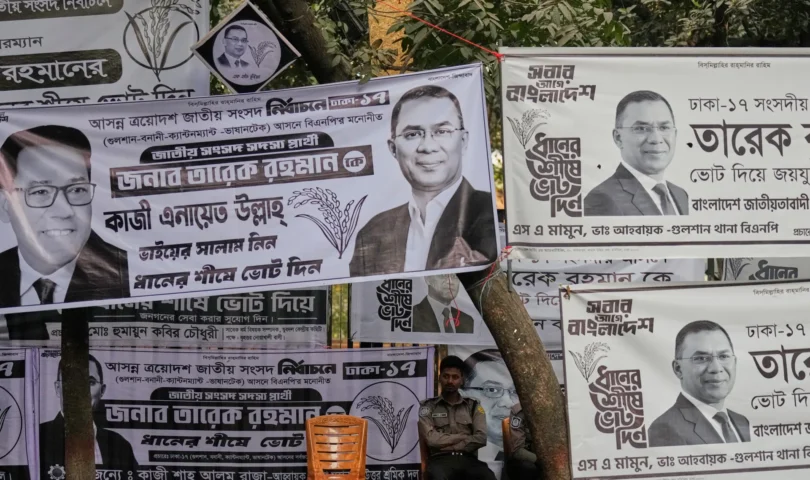
DHAKA: Bangladesh has entered a new political era as the Bangladesh Nationalist Party (BNP) secured a commanding majority in the country’s first general election since the 2024 student-led uprising, while voters simultaneously backed a sweeping reform agenda through a national referendum.
BNP on course to form government
According to the latest figures released by the Election Commission Bangladesh, the BNP has won 209 seats out of 297 announced results, putting the party in a decisive position to form the next government.
Party chief Tarique Rahman, who returned to the country shortly before the elections after years in exile, is now widely expected to become the next prime minister once the results are formally notified.
In the capital, the BNP dominated the electoral map, securing 13 of Dhaka’s 20 seats, reinforcing its nationwide organisational strength and campaign momentum built over the past year.
Jamaat’s strongest parliamentary return
The Bangladesh Jamaat-e-Islami emerged as the main opposition party, winning 68 seats, its strongest performance in decades and signalling a major shift in Bangladesh’s parliamentary balance.
The protest-born National Citizen Party (NCP) finished third with six seats, but its leader Nahid Islam won his constituency, becoming one of the youngest members of the new parliament and ensuring the student movement retains a direct voice inside the legislature.
Awami League absent from the contest
The election took place without the Awami League, which was barred from participating after the fall of Sheikh Hasina’s government in 2024. Hasina remains in India, and her absence — both politically and physically — has reshaped the country’s political landscape.
The new parliament is therefore expected to be the most politically diverse in years, ending the era of a one-party dominated legislature.
Voter turnout and credibility
The Election Commission reported a voter turnout of nearly 60 percent, describing the polls as among the most peaceful and credible in recent decades — a significant development after years of disputed elections.
Referendum backs structural reforms
Alongside electing a new parliament, Bangladeshis voted on the “July Charter”, a reform package drafted after the uprising.
Early results show a clear majority — more than 60 percent — in favour of the reforms, which include:
Term limits for the prime minister
Expansion of fundamental rights
Greater judicial independence
Increased political representation for women
Creation of a 100-member upper house
While major parties broadly support the reform roadmap, differences remain over the method of forming the proposed upper chamber — an issue likely to shape parliamentary negotiations in the coming months.
Allegations over results process
Despite the overall peaceful polling, several parties — including the NCP and Jamaat — have raised concerns over the results process, citing alleged irregularities and delays in detailed turnout data. The Election Commission has yet to issue the final certified results.
Why the BNP win was expected
Political observers say the outcome reflects:
BNP’s nationwide organisational network
Strong mobilisation on issues such as inflation and unemployment
Tarique Rahman’s return boosting party morale
Its role in the anti-Hasina protest wave
What comes next
The focus now shifts from the ballot box to governance.
Analysts say the incoming administration will face immediate challenges:
Restoring law and order
Delivering economic stability
Implementing constitutional reforms
Managing a more competitive parliament
Recalibrating foreign relations, particularly with India
At the same time, the presence of Jamaat as a strong opposition and the entry of youth-origin lawmakers means parliamentary politics is expected to be more active and contested than in the past decade.
A post-Hasina political order
For the first time in years, Bangladesh’s legislature will function without the Awami League, a development many observers describe as a structural turning point.
The election has not only changed the ruling party, but it has reconfigured the entire political field, bringing together:
A returning major party in power
A resurgent Islamist opposition
A protest-born youth force inside parliament
A reform mandate backed by voters
Together, these elements point toward a new and more competitive phase in Bangladesh’s democratic evolution.
Muhammad Nasir Butt is reporting from Dhaka for Pakistan Narrative