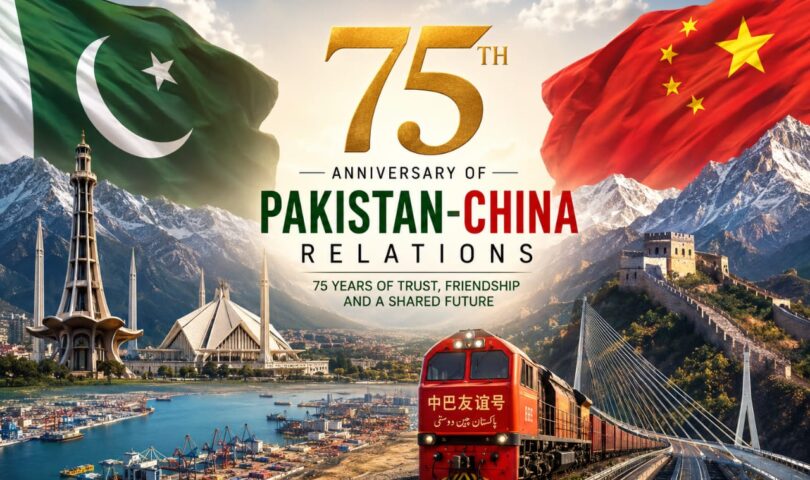
For decades, international relations have often been described through the language of interests, power blocs, military alliances, and economic competition. Yet amid shifting global equations, one relationship has consistently stood apart for its endurance, trust, and strategic depth: the friendship between Pakistan and China.
As Pakistan and China mark the 75th anniversary of diplomatic relations, the partnership today is no longer merely a symbolic friendship between neighboring states. It has evolved into one of Asia’s most consequential strategic relationships — a bond that is increasingly shaping regional connectivity, trade routes, technology partnerships, education, and geopolitical balance.
Having spent years traveling between Pakistan and China, and witnessing Chinese society not only as a journalist but also as a resident and observer, I have personally seen how deeply the people-to-people connection between the two countries has grown beyond official diplomacy.
A Relationship Built Before It Became Popular
Pakistan was among the earliest countries to recognize the People’s Republic of China in 1950, long before many Western nations adjusted their policies toward Beijing. At a time when global politics was sharply polarized, Islamabad chose engagement over isolation.
That decision laid the foundation for what Chinese leaders often describe as an “iron brotherhood.”
Over the decades, Pakistan and China stood beside each other during wars, political transitions, economic crises, natural disasters, and moments of diplomatic pressure. Unlike many transactional international partnerships, the Pakistan-China relationship survived changes in governments, ideologies, and international alignments.
Today, from the Karakoram Highway to Gwadar Port, from defense cooperation to educational exchanges, the relationship has transformed into a multidimensional strategic partnership.
China’s Rise and the New Global Reality
The world of 2026 is vastly different from the world of previous decades. China is no longer merely a manufacturing giant; it has emerged as a central pillar of the global economy.
Chinese influence now extends across global markets, artificial intelligence, electric vehicles, digital infrastructure, renewable energy, logistics, and international finance. From Southeast Asia to Africa, from the Middle East to Europe, China’s economic footprint continues expanding at an unprecedented pace.
Chinese companies are reshaping industries worldwide. Whether it is electric vehicle technology, solar energy production, high-speed rail networks, or e-commerce ecosystems, Beijing’s economic model has become impossible for global markets to ignore.
This growing influence is also visible diplomatically.
Recent high-profile visits by world leaders, including Russian President Vladimir Putin and renewed engagement by U.S. President Donald Trump toward China-related global trade discussions, demonstrate an important reality: regardless of political competition, the world still recognizes China as an indispensable global power.
Even nations that publicly challenge Beijing’s rise continue engaging China economically because modern global supply chains, industrial production, and technological ecosystems are now deeply interconnected with Chinese markets.
China is no longer simply participating in globalization — in many ways, it is redefining it.
Why Pakistan Matters in China’s Strategic Vision
For Pakistan, relations with China are not merely important; they are strategically essential.
Pakistan sits at the crossroads of South Asia, Central Asia, and the Middle East. Through the China-Pakistan Economic Corridor (CPEC), Islamabad became one of the most significant partners in China’s Belt and Road Initiative.
CPEC was never just about roads and infrastructure. It represented connectivity, regional integration, energy security, industrial development, and long-term strategic cooperation.
Despite political criticism and international skepticism, CPEC changed Pakistan’s infrastructure landscape. Highways, energy projects, ports, and urban development initiatives helped reshape economic possibilities for the country.
But perhaps even more importantly, China consistently treated Pakistan as a trusted strategic partner rather than merely a temporary ally.
At a time when international politics is increasingly uncertain, Pakistan’s stable relationship with China provides diplomatic balance and economic opportunity.
The Human Side of the Pakistan-China Relationship
While governments sign agreements and leaders exchange visits, the strongest relationships are ultimately built by people.
As someone living between Pakistan and China, I have witnessed firsthand how warmly Pakistani students and families are treated across Chinese cities.
From Wuhan to Beijing, from Shanghai to smaller university towns, Pakistani students are often viewed with respect and affection. Universities provide support systems for international students, local communities show curiosity toward Pakistani culture, and many Chinese citizens genuinely consider Pakistan a friendly nation.
One of the most remarkable aspects of Chinese society is its emphasis on collective harmony, public safety, discipline, and respect for guests. Pakistani families living in China frequently describe feeling secure, welcomed, and appreciated.
During difficult global periods including the COVID-19 pandemic the people-to-people connection between Pakistanis and Chinese communities became even more visible. Many Pakistani students received institutional support, care, and assistance from Chinese universities and local administrations during uncertain times.
These experiences create emotional connections that go far beyond diplomacy.
For many Pakistanis living in China, the relationship is not an abstract geopolitical concept; it is something experienced daily in classrooms, markets, neighborhoods, and workplaces.
A Partnership Beyond Governments
The future of Pakistan-China relations will depend not only on strategic projects but also on cultural understanding, educational exchanges, tourism, media cooperation, and technological collaboration.
There remains enormous potential for joint ventures in digital media, artificial intelligence, agriculture, education, renewable energy, and innovation ecosystems.
Pakistan’s young population and China’s technological advancement create opportunities for cooperation that could define the next generation of Asian development.
However, Pakistan must also understand an important reality: strong friendships require internal strength. To fully benefit from Chinese partnership, Pakistan must improve governance, economic planning, institutional stability, and long-term policy continuity.
China can provide opportunity and partnership — but Pakistan itself must build sustainable systems to maximize those opportunities.
The Road Ahead
Seventy-five years after establishing diplomatic ties, Pakistan and China stand at another historic moment.
The global order is changing rapidly. Economic power centers are shifting toward Asia. New alliances are emerging. Technology is redefining geopolitics. Trade corridors are reshaping strategic calculations.
In this transforming world, Pakistan-China relations remain one of the few partnerships that have demonstrated consistency, trust, and resilience over generations.
For Pakistan, China is not just a neighboring superpower. It is a strategic partner, an economic collaborator, and increasingly, a societal connection built through education, culture, and people-to-people engagement.
And for many Pakistanis who have lived in China, the friendship carries a deeply personal meaning.
Seventy-five years later, the slogan still survives because millions on both sides continue to believe in it:
Pakistan-China friendship is higher than the mountains, deeper than the oceans, sweeter than honey, and stronger than steel.