NEW DELHI: India and South Korea on Monday agreed to significantly expand economic cooperation, setting a target to double bilateral trade to $50 billion by 2030.
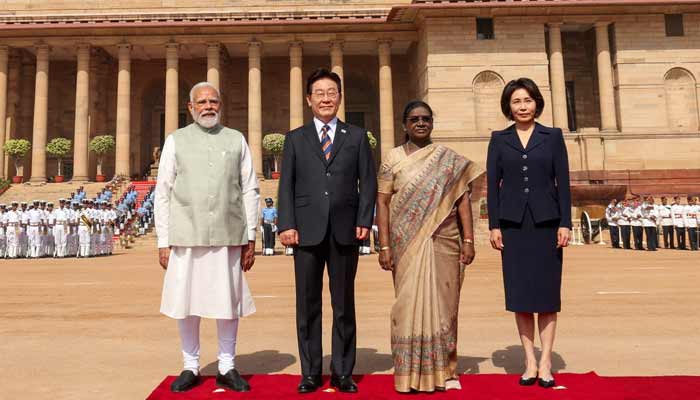
The understanding was reached during talks between Indian Prime Minister Narendra Modi and South Korean President Lee Jae Myung, who is on a three-day visit — the first by a South Korean president to India in eight years.
“We decided to upgrade the framework of economic cooperation between the two countries to create a new engine for shared growth,” Lee said after the meeting.
Both sides agreed to expand collaboration across key sectors, including energy, critical minerals, shipbuilding, semiconductors, and steel. They also decided to resume and accelerate negotiations to revamp their 2010 trade agreement, aiming to address trade imbalances and improve market access.
A ministerial-level economic cooperation committee will be established for the first time to oversee joint initiatives, with a focus on nuclear energy, clean energy, trade, and investment.
Highlighting global energy concerns amid ongoing geopolitical tensions, Lee said both countries would work closely to ensure stable supplies of energy resources and raw materials.
Modi described the visit as highly significant, stating that both nations had taken “important decisions” to strengthen trade and economic ties. “Today, we are laying the foundation for the success story of the next decade,” he said.
Separately, Indian Commerce Minister Piyush Goyal held discussions with his South Korean counterpart Yeo Han-koo on revitalising the trade pact and enhancing cooperation in green energy, industry, and digital trade.
On the business front, major South Korean companies including Samsung Electronics, Hyundai Motor, and LG Group are expected to participate in a joint business forum, alongside plans to sign around 20 private-sector agreements covering sectors such as shipbuilding, energy, and digital technology.
In a significant investment move, Posco Holdings announced plans to partner with India’s JSW to build a $1.09 billion integrated steel plant in Odisha, with a projected capacity of six million tonnes annually.
Despite growing economic ties, trade imbalances remain a concern. South Korea recorded a trade surplus of $12.8 billion with India last year, underscoring New Delhi’s push for a more balanced relationship.
Lee is scheduled to travel to Vietnam following the conclusion of his visit to India.