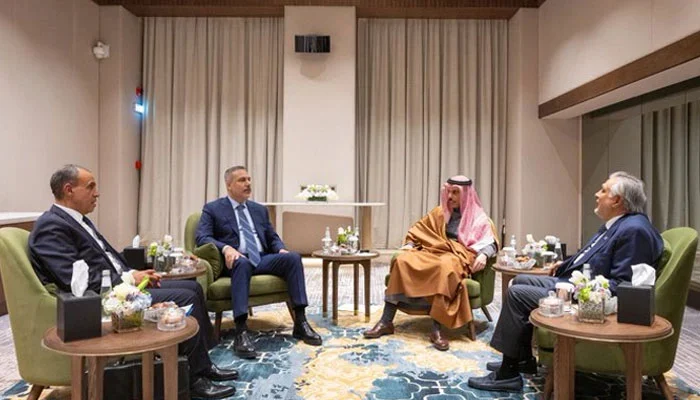
ISLAMABAD: Pakistan is set to host a crucial quadrilateral meeting of foreign ministers from Saudi Arabia, Turkiye and Egypt on March 29-30 in Islamabad, aimed at discussing regional developments and efforts to reduce tensions amid the ongoing US-Israeli war on Iran.
The meeting comes as Islamabad has emerged as a key diplomatic facilitator between Iran and the United States, relaying messages between the two sides in an effort to create space for dialogue and end the conflict that began on February 28.
Turkish Foreign Minister Hakan Fidan and Egyptian Foreign Minister Badr Abdelatty have already arrived in Islamabad, while Saudi Foreign Minister Prince Faisal bin Farhan Al Saud is expected to reach the capital today.
Officials said the two-day talks will focus on de-escalation efforts and broader regional stability, as the conflict continues to impact the Middle East and global energy markets.
Deputy Prime Minister and Foreign Minister Ishaq Dar recently confirmed that indirect communication between Washington and Tehran was under way through Pakistan, with support from Turkiye and Egypt.
These diplomatic efforts have also involved high-level contacts, including communication between Pakistan’s military leadership and US President Donald Trump, according to the White House. Pakistan has conveyed proposals from Washington to Tehran as part of ongoing mediation attempts.
However, Iran has rejected a US proposal, maintaining that it will end what it calls an “imposed war” on its own terms. Tehran has outlined conditions including a halt to attacks, guarantees against future aggression, reparations, and international recognition of its control over the Strait of Hormuz.
As part of the diplomatic push, Prime Minister Shehbaz Sharif held a detailed telephone conversation with Iranian President Masoud Pezeshkian, focusing on de-escalation and dialogue. The prime minister reiterated Pakistan’s condemnation of attacks on Iran and expressed solidarity with its people, while also highlighting Islamabad’s outreach to global and regional stakeholders.
Meanwhile, Ishaq Dar held separate meetings with his Egyptian and Turkish counterparts in Islamabad, where discussions covered both bilateral ties and the evolving Middle East situation. The leaders stressed the need for restraint, dialogue and diplomatic solutions to resolve the conflict.
Dar also reaffirmed Pakistan’s support for the Palestinian people and condemned ongoing Israeli actions in Gaza and the West Bank, while appreciating Egypt’s role in facilitating humanitarian assistance.
In a separate development, the deputy prime minister held a telephonic conversation with Iranian Foreign Minister Abbas Araghchi, during which both sides discussed the evolving situation. Dar emphasised that dialogue and diplomacy remain the only viable path to lasting peace and called for an immediate end to hostilities.
Officials say the Islamabad meeting could play a significant role in shaping coordinated regional efforts to de-escalate tensions and explore possibilities for negotiations between the involved parties.