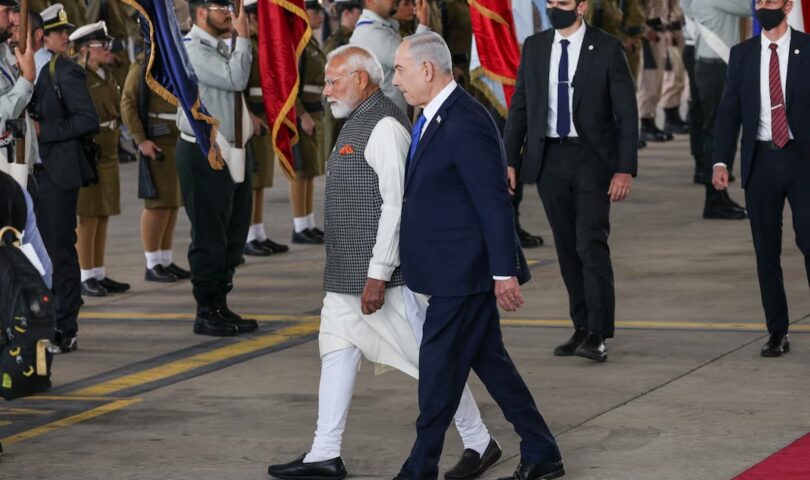
Indian Prime Minister Narendra Modi’s visit to Israel and his address to the Knesset represent far more than a ceremonial diplomatic engagement; they signal a deepening strategic alignment that carries direct implications for Pakistan’s security environment, regional diplomacy and narrative space. At a time when Israel faces growing international criticism over its war in Gaza, Modi’s public endorsement provided Tel Aviv with political legitimacy and demonstrated New Delhi’s willingness to position itself as a long-term strategic partner in defence, technology and geopolitical coordination. For Pakistan, this development must be examined not through an emotional lens but as part of a broader structural shift in the regional balance of power.
The strengthening India–Israel partnership has long been rooted in defence cooperation, but it is now expanding into advanced domains such as artificial intelligence, missile defence systems, cyber security, semiconductors and digital financial integration. This evolution has direct security consequences for South Asia. Israeli military technology, which is widely regarded as combat-tested and operationally sophisticated, acts as a force multiplier for India by enhancing its surveillance capability, precision strike potential and network-centric warfare architecture. Any future joint production or co-development of next-generation weapons systems will further widen the technological gap in the conventional domain, thereby placing greater pressure on Pakistan’s deterrence stability and defence modernisation efforts.
At the diplomatic level, Modi’s visit reflects India’s growing confidence in pursuing a multi-aligned foreign policy that simultaneously engages Israel, the Gulf states, the United States and Europe. This model reduces New Delhi’s dependence on any single bloc and enhances its global manoeuvrability. For Pakistan, the implications are significant. India’s expanding economic footprint in the Middle East, combined with its strategic partnership with Israel, challenges Islamabad’s traditional diplomatic space in a region where it has historically enjoyed deep political, military and people-to-people ties. At the same time, India’s ability to maintain relations with Arab capitals while openly embracing Israel demonstrates a pragmatic foreign policy approach that Pakistan must study carefully.
Equally important is the narrative dimension. India’s foreign policy moves are consistently accompanied by coordinated global messaging, diaspora lobbying and strong media projection. By standing firmly with Israel in its parliament and avoiding any meaningful reference to Palestinian suffering, Modi signalled a clear prioritisation of strategic interests over historical positioning. This shift weakens the long-standing perception of India as a traditional supporter of Palestine and allows New Delhi to reposition itself as a key security and technology partner for Western and pro-Israel strategic circles. For Pakistan, which has consistently maintained a principled stance on Palestine, this creates both a challenge and an opportunity. The challenge lies in India’s rising global influence; the opportunity lies in Pakistan’s potential to reclaim moral and diplomatic leadership on issues of international law, self-determination and human rights.
The visit also intersects with the evolving regional security discourse on Afghanistan. In recent years, India has repeatedly expressed concern about terrorist groups operating from Afghan territory, particularly those it claims threaten regional stability. This narrative has been echoed in various international forums and strategic dialogues, where New Delhi has attempted to link the Afghan security vacuum with broader South Asian counterterrorism frameworks. Such positioning is not merely about Afghanistan; it is part of a larger effort to project India as a net security provider in the region while simultaneously placing indirect diplomatic pressure on Pakistan. By aligning closely with Israel, a country that frames its security doctrine around pre-emptive action, advanced surveillance, and cross-border counterterrorism operations, India gains both technological tools and a legitimising narrative for its own security posture.
For Pakistan, the Afghanistan factor is critical. Islamabad has consistently argued that a peaceful and stable Afghanistan is essential for regional connectivity, economic integration, and counterterrorism cooperation. However, if India succeeds in embedding its security concerns regarding Afghanistan into its strategic partnerships with Israel and Western powers, it could reshape international perceptions in ways that complicate Pakistan’s diplomatic messaging. The emerging discourse risks sidelining Pakistan’s role as the country most directly affected by instability in Afghanistan and the one that has borne the greatest human and economic cost of decades of conflict.
Another dimension that can not be ignored is the economic and technological competition embedded in the India–Israel partnership. Cooperation in high-tech sectors such as AI, fintech, quantum computing, and defence innovation is not only about military strength but also about shaping the future global economy. India’s access to Israeli innovation ecosystems, combined with its own large market and human capital, positions it as a major player in the technology-driven world order. This has long-term implications for Pakistan’s economic competitiveness and highlights the urgency of building strong technology partnerships with countries such as China, Türkiye and Central Asian states.
The broader geopolitical context further amplifies the significance of this visit. With rising tensions in the Middle East, the possibility of new regional alignments and the increasing militarisation of strategic partnerships, India’s presence alongside Israel sends a message that it seeks a role beyond South Asia. It aims to be an active participant in shaping the security architecture of the wider region. This ambition directly affects Pakistan because it alters threat perceptions, alliance patterns, and diplomatic equations that have historically defined regional politics.
In this environment, Pakistan’s response must be strategic rather than reactive. The country possesses significant strengths, including its geostrategic location, its role in regional connectivity projects, its long-standing ties with key Muslim countries, and its credible deterrence capability. However, these strengths must be complemented by a proactive narrative strategy, deeper investment in indigenous technological development, and a more dynamic diplomatic outreach. The contest is no longer confined to conventional military power; it is equally about influence in global discourse, control of emerging technologies, and the ability to build resilient international partnerships.
Modi’s Israel visit is, therefore, not an isolated diplomatic event but a reflection of a changing world order in which alliances are increasingly defined by technology, security cooperation, and narrative dominance. For Pakistan, it serves as a strategic wake-up call. The country must recalibrate its foreign policy, strengthen its regional and global partnerships, and invest in the information domain where perceptions are shaped and power is projected. In the emerging multipolar landscape, the states that succeed will be those that combine hard power with economic innovation and narrative credibility. Pakistan’s challenge is to move from a position of response to one of initiative and to do so with clarity, confidence, and strategic foresight.