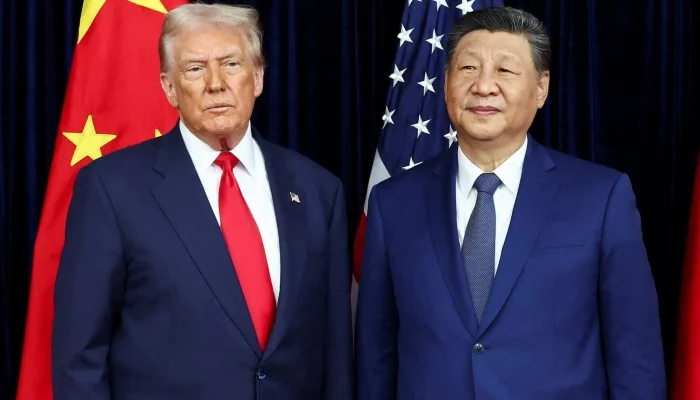
WASHINGTON: US President Donald Trump announced on Thursday that Washington and Beijing have reached a new trade understanding under which the United States will reduce tariffs on Chinese imports to 47% in exchange for China resuming US soybean purchases, maintaining rare earth exports, and intensifying efforts against the illicit fentanyl trade.
The announcement came shortly after Trump’s face-to-face meeting with Chinese President Xi Jinping in the South Korean port city of Busan — their first encounter since 2019 — held on the sidelines of the Asia-Pacific Economic Cooperation (APEC) Summit.
“This was an amazing meeting,” Trump told reporters aboard Air Force One as he departed Busan. “The tariffs will come down to 47% from 57%, and we’re going to see tremendous progress on trade, rare earths, and fentanyl control.”
A Trade Thaw After Years of Tension
The meeting marked the culmination of Trump’s whirlwind Asia tour, during which he also claimed “historic progress” on trade with South Korea, Japan, and Southeast Asian nations.
World markets, which had soared in anticipation of a breakthrough between the world’s two largest economies, saw mixed reactions following Trump’s announcement. Major Asian and European stock indexes fluctuated, while China’s Shanghai Composite Index dipped from a decade-high and US soybean futures softened slightly amid uncertainty over implementation timelines.
Despite volatility, analysts described the outcome as a “tentative thaw” in a long-running trade dispute that has disrupted global supply chains and strained business confidence.
‘Normal to Have Frictions,’ Says Xi
At the start of their meeting, Xi reportedly told Trump — through a translator — that “it is normal for the two leading economies of the world to have frictions now and then.” The discussion, which lasted nearly two hours, was described by both sides as “constructive and forward-looking.”
Trump personally escorted Xi to his car after the talks before receiving a red-carpet sendoff at Gimhae International Airport.
According to US Trade Representative Jamieson Greer, the talks also produced an understanding on rare earth exports, a key issue in the trade standoff.
Rare Earth Issue ‘Settled,’ Trump Claims
Trump said that China has agreed to maintain the global supply of rare earth elements under a one-year arrangement that he expects will be extended. “All of the rare earth has been settled,” Trump said. “There is no roadblock at all on rare earth — that will hopefully disappear from our vocabulary for a little while.”
China has not yet issued an official statement clarifying the details of the agreement.
Rare earth elements — a group of 17 minerals critical for manufacturing electronics, electric vehicles, and defense technologies — have become one of Beijing’s most powerful trade levers in recent years. Chinese export restrictions imposed earlier in 2025 led to global shortages, forcing automakers and electronics manufacturers to slow production.
While it remains unclear whether the Busan understanding covers existing controls or only those announced in October, US officials expressed confidence that China will suspend planned restrictions that were due to take effect in early November.
A Cautious Optimism
Though the Busan meeting may mark a temporary easing of trade tensions, analysts note that deeper divisions persist between Washington and Beijing on technology transfers, intellectual property, and geopolitical issues such as Taiwan and the South China Sea.
Still, Trump hailed the development as “a major victory for American farmers and manufacturers”, emphasizing that China will immediately resume large-scale soybean imports.
As Air Force One departed for Washington, Trump told reporters, “This is just the beginning — we’ve opened the door to real cooperation with China again.”
If confirmed and implemented, the Busan deal could represent the most significant reset in US-China trade relations since the first “Phase One” agreement signed in 2020.