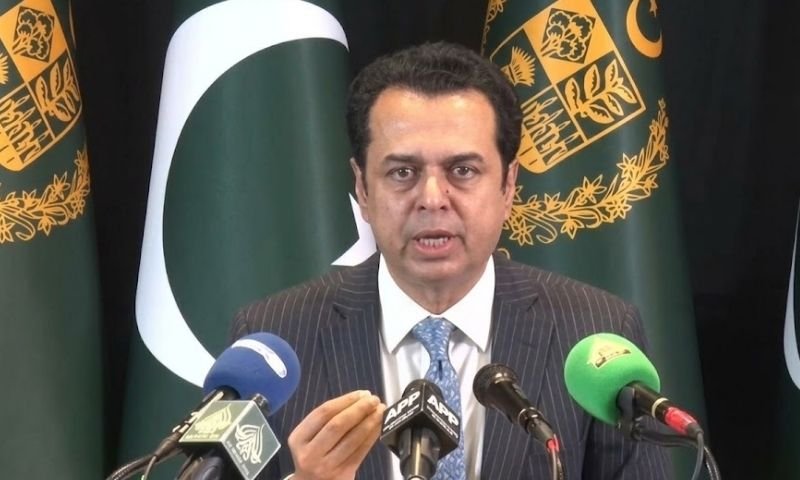
ISLAMABAD: State Minister for Interior Talal Chaudhry on Tuesday said the government had made “political and constitutional arrangements” to deal with the Pakistan Tehreek-e-Insaf’s (PTI) long march, warning that it would be the country’s last and that there had been enough leniency.
Speaking at a press conference in Islamabad, Chaudhry said there would be no further talks with the opposition unless an agreement was reached on terrorism.
He said dialogue could move forward only under certain conditions, adding that eliminating terrorism was essential and that national security and stability had to remain the priority.
Chaudhry accused the PTI of deliberately preventing the negotiations from producing a result and alleged that the opposition was concealing facts about the talks.
He said the government had believed that a “Charter of Democracy 2” was within reach, but Khyber Pakhtunkhwa Chief Minister Sohail Afridi had placed conditions before the negotiators at the last moment.
According to Chaudhry, the talks initially focused on ending terrorism in the province, but terrorism-related matters were later sidelined.
He said points relating to counterterrorism had been agreed in the first phase, after which political issues were taken up.
On the first day of negotiations, he said, Interior Minister Mohsin Naqvi presented the government’s position on the KP government’s cooperation under the National Action Plan, including what he described as its backtracking on commitments relating to security forces and budgets.
Chaudhry said the fight against terrorism was a national issue and did not belong to any particular political party.
“We are fighting a war for Pakistan’s protection and security,” he said.
He said the government wanted to provide the opposition with as much political space as possible but urged the PTI not to “nurture terrorists”.
On the use of drones, Chaudhry said the PTI’s opposition to drone operations would weaken the security forces, claiming that militants were using drones from Afghanistan to target security camps and police stations.
He said drones had become essential in modern warfare, internal security and even traffic management.
“Do you want our security forces to be rendered helpless, so that they cannot use the most effective weapons?” he asked.
Chaudhry said Naqvi had contacted opposition leaders by phone the night before the talks and asked them to bring a representative of the KP government, preferably the chief minister.
At the first meeting, he said, the opposition representatives stated that the entire party, including the KP government, had authorised them to speak on its behalf.
Some opposition leaders subsequently travelled to Peshawar, met the chief minister and senior leaders, and returned with fresh assurances on the terrorism-related points.
Naqvi later posted the assurances on X, Chaudhry said, adding that the government was again told there was “100 per cent” agreement.
The state minister said Naqvi then met Prime Minister Shehbaz Sharif in Lahore, where the premier directed that the opposition should be given as much political space as possible provided it fully cooperated on terrorism.
According to Chaudhry, the prime minister referred to the default crisis, saying difficult decisions had cost his party political capital but helped save the country.
Chaudhry said the first draft of the agreement covered all political matters, including the PTI founder’s health, meetings with him and cases involving other leaders.
The draft was finalised at around 9pm, after which Naqvi left to take it to the president, he said.
According to Chaudhry, changes were subsequently made several times, with agreement reached on each occasion, while the remaining differences were limited to a few words.
He said the opposition then sat in a separate room while remaining in contact with the KP chief minister.
“When they came out, they could not meet our eyes,” Chaudhry said, adding that the opposition delegation then sought permission to leave.
“Every day the prime minister and the army chief shoulder the funerals of young men, some married a week earlier,” he said. “There is no greater victory for us than this.”
Chaudhry also questioned why the PTI appeared to have remained safe from militant attacks.
“Is this your armed wing?” he asked, claiming that no PTI leader had been attacked by the Tehreek-e-Taliban Pakistan (TTP) or other militant groups in 11 years.
He also said the PTI government had formulated National Action Plan 2 and questioned why the party was now objecting to it.
The government and opposition held an extended round of talks that ended without agreement, with both sides blaming each other for the deadlock.
The PTI subsequently began its long march from Lakki Marwat in Khyber Pakhtunkhwa towards Islamabad.
Chaudhry also pointed out that examinations in Peshawar had been postponed in view of the march.