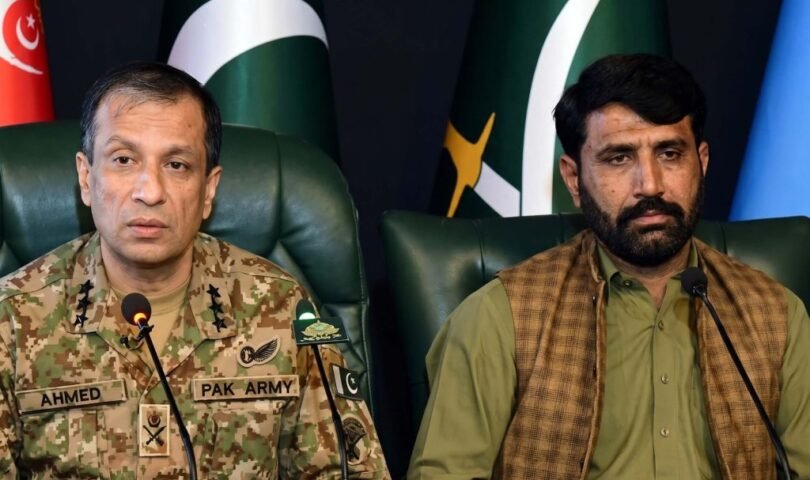
ISLAMABAD: Inter-Services Public Relations (ISPR) Director General Lt Gen Ahmed Sharif Chaudhry on Thursday presented a former Pakistan Army soldier before the media after Indian authorities identified a slain militant as a former Pakistani soldier, challenging the Indian account and describing the episode as another “false flag operation”.
Havaldar Muhammad Asif, whom Indian reports had identified as Lashkar-e-Taiba (LeT) commander Mohammad Asif alias Hashim Musa, appeared at the press conference and said he was alive and had been living with his family in Rawalpindi after retiring from the Special Services Group (SSG) in 2023.
Chaudhry said the episode began on the night of September 29, when the Indian Army formation responsible for Indian Illegally Occupied Jammu and Kashmir (IIOJK) posted on X that it had launched a joint search operation in the general area of Korag, Yousmarg, on the basis of “specific intelligence inputs”.
According to the Indian Army’s account, troops from the army, Jammu and Kashmir Police and Central Reserve Police Force (CRPF) observed suspicious activity and came under fire after challenging suspected militants. An exchange of fire followed, during which one militant was “neutralised”, Chaudhry said while reading out the Indian Army’s account.
The Indian Army issued another update on the morning of September 30, saying troops conducting an early-morning search in the general area of Palmaidan had recovered the body of a Pakistan-based LeT militant identified as Mohammad Asif alias Hashim Musa. The Army said the body was recovered along with “war-like stores”.
Chaudhry said the Indian side subsequently provided further details through news agency ANI, identifying Asif as a former Pakistan Army soldier.
According to ANI reports cited by the DG ISPR, Asif was born on March 7, 1980, joined the Pakistan Army in 2000 and retired with the rank of havaldar. The reports also claimed he had served with the SSG and performed VIP security duties.
Chaudhry said Indian authorities later changed the description of the slain militant, identifying him as LeT commander Musa alias Asif Fauji.
He said Indian authorities described the operation as intelligence-led and claimed Musa had been operating in IIOJK since 2022.
The Indian Ministry of Home Affairs had earlier said Musa was killed in an intelligence-led joint operation at Gurwatkalan in Budgam and described his death as a serious blow to the LeT network in IIOJK.
According to the Indian account, Musa was one of four senior LeT commanders operating in the region since 2022 and the operation was part of “Operation Sheruwali”, which India said had been launched in May 2026.
Chaudhry said Indian authorities had attributed several attacks to Musa, including the Halan attack in August 2023, DKG attack in December 2023, Kandi attack in May 2023, Shah Sitar attack in May 2024, Shiv Khori attack in June 2024, Gagan Geer attack in October 2024, Boota Pahari attack in October 2024 and Basira attack in April 2025.
He said India had also claimed that three other members of the group — Junaid Bhatt, Suleman and Yasir — were killed in separate encounters.
Chaudhry questioned the Indian account and described the episode as another “false flag operation”.
He said Indian media outlets subsequently carried the claims, naming News18, The Statesman, India Today, Hindustan Times, ABP Live and The Indian Express.
The DG ISPR also referred to social media posts linking Musa’s photograph to various incidents, including the April 2025 Pahalgam attack, and attributing different militant activities to him.
Indian authorities have previously accused Pakistan-based militants of involvement in the Pahalgam attack, allegations Islamabad has rejected.
Former soldier appears before media
Chaudhry said that since Indian authorities had claimed Musa was an ex-havaldar of the SSG, Pakistan decided to establish where the individual was actually located.
He then invited Havaldar Muhammad Asif to appear before the media and displayed an Indian Army graphic identifying “Muhammad Asif alias Hashim Musa” as the militant whose body, according to the Indian Army’s Chinar Corps, had been recovered on September 30.
Asif said he was from Pindi Gheb tehsil of Attock district and that friends had contacted him after seeing social media reports claiming that he had been killed by the Indian Army in IIOJK.
“They asked me, ‘Where are you?’ I said, ‘I am speaking to you, I am in front of you, and I am alive, Alhamdulillah,’” Asif said.
He said he subsequently received calls from Indian numbers, with callers asking for personal information, including where he lived and details about his family.
Asif said he later learned through social media that Indian media outlets had used his personal information to report that he had been killed in an operation in IIOJK.
“I was myself very surprised. What is happening? I am sitting at home, and they have killed me somewhere,” he said.
He said he informed his former unit about the reports and was advised to block the numbers and wait for ISPR to contact him.
Asif said ISPR officials later contacted him and asked whether he was the person reported to have been killed.
“I said, ‘I am alive.’ They said, ‘Then you should come and tell the details and make it clear that you are alive,’” he said.
He said he joined the Pakistan Army in 2000 in the artillery and joined the SSG in 2005.
“I served for 18 years with great courage and retired from the SSG in 2023,” he said.
After retiring, Asif said he worked for three years with a private security company and had been living with his family in Rawalpindi for the past three to four months.
He rejected the allegations against him as “false” and “baseless”.
“I condemn this. Alhamdulillah, I am alive and standing before you,” he said, adding that he could produce his identity card to establish his identity.
DG ISPR accuses India of using terrorism narrative
Chaudhry said the episode was an attempt to divert attention from what he described as India’s own problems and accused New Delhi of supporting terrorism in the region.
He alleged that India had sponsored, funded or supported militant organisations in the region over the decades, citing groups including the Mukti Bahini, Liberation Tigers of Tamil Eelam (LTTE), Tehreek-e-Taliban Pakistan (TTP) and Balochistan Liberation Army (BLA).
He also alleged that terrorism had acquired an internal dimension in India and accused Indian authorities of seeking to externalise internal problems.
The DG ISPR said Kashmir was another factor behind what he described as India’s repeated allegations against Pakistan.
He alleged that a large number of military, security, intelligence, CRPF and law-enforcement personnel were deployed in IIOJK and accused Indian authorities of imposing restrictions and committing abuses against Kashmiris.
Chaudhry said Pakistan could not be blamed for India’s internal problems and alleged that New Delhi sought to portray unrest in IIOJK as being driven by Pakistan.
He also played video clips which he said showed alleged incidents of torture and human rights abuses in IIOJK.
The Indian government has rejected allegations of systematic abuses and maintains that its security operations in the region are aimed at countering militancy.
DG ISPR criticises Indian media narrative
Chaudhry said another factor was what he described as India’s “obsession with Pakistan”.
He said Pakistan was blamed whenever an incident occurred in India and urged Indian authorities to provide evidence for their allegations.
“If you have proof, please come forward,” he said, adding that India could provide evidence to a third party if it did not want to share it directly with Pakistan.
Chaudhry also criticised what he described as India’s reliance on “theatre and drama” and referred to several past incidents and encounters.
He alleged that the Indian Army’s Chinar Corps, Press Information Bureau, Home Department and sections of the Indian media had promoted a common narrative.
Pakistan prepared for any Indian action
Responding to questions about possible tensions on the eastern border while Pakistan was facing security challenges on its western frontier, Chaudhry said Pakistan was prepared for any action India might take.
“As far as India is concerned, we are prepared for everything that they are ready to do,” he said.
He described Pakistan’s own strength as the “biggest guarantee of peace” in the region.
Chaudhry said Pakistan’s political and military leadership and armed forces had complete confidence in the country’s strength and its position.
He also dismissed a question about how the “spirit” of Muhammad Asif had supposedly returned after Indian authorities claimed to have killed him.
He said Asif’s “spirit” had never gone anywhere and was present before the media.
Pakistan to decide response to Afghanistan
Asked about increased Pakistani strikes in Afghanistan and whether ground forces could be involved in future operations, Chaudhry said Pakistan would decide “what we will do and when we will do” with the Afghan Taliban regime.
“That’s our prerogative,” he said.
He accused the Afghan Taliban regime of facilitating terrorism and questioned the presence of Afghan nationals in militant formations allegedly entering Pakistan to carry out attacks.
Earlier on Thursday, Pakistan had said it carried out “well-planned and calibrated” aerial strikes against alleged terrorist hideouts at two locations in Afghanistan, with initial reports suggesting that 22 militants were killed.
Chaudhry said Pakistan would take whatever measures were necessary to safeguard its citizens, particularly in Khyber Pakhtunkhwa and Balochistan.
He stressed that Pakistan had “nothing against the Afghan people”.
“Absolutely nothing. We have got nothing against Afghanistan. The problem is with this Afghan Taliban regime,” he said.
The DG ISPR described the Afghan Taliban government as non-inclusive, non-representative and unelected and alleged that it was providing a security environment for militant organisations.
He named groups including Al-Qaeda in the Indian Subcontinent (AQIS), Islamic State Khorasan (ISKP), East Turkestan Islamic Movement (ETIM) and Islamic Movement of Uzbekistan (IMU), among others, as operating from Afghanistan.
DG ISPR alleges militant coordination in Kandahar
Chaudhry also referred to what he described as an August 26 meeting in Kandahar, allegedly chaired by Mullah Shirin, the Taliban-appointed governor of Kandahar.
He alleged that representatives of Al-Qaeda, Bashir Zeb, Gul Bahadur and the Afghan Taliban attended the meeting to coordinate their activities.
He further alleged that the BLA had raised recruitment problems and that Gul Bahadur was being asked to provide manpower that would then be placed in BLA uniforms.
The Afghan Taliban have not publicly confirmed the specific allegations cited by the DG ISPR.
Army says it has no role in politics
Responding to a question about reports of meetings between senior military officials and PTI founder Imran Khan at Adiala Jail, Chaudhry said the Army had “nothing to do with politics” and would not comment on political matters.
“Politics is for the political parties. Governments are made by politicians. It is for the government and political parties,” he said.
He urged journalists not to involve the Army in political matters.
Jadhav case is government’s domain
Asked about the legal status of Indian national Kulbhushan Jadhav and why no action had been taken regarding his sentence, Chaudhry said the government and Ministry of Law and Justice were best placed to provide details.
He referred to Jadhav as a major issue for India and repeated Pakistan’s allegations concerning his activities.
India has rejected Pakistan’s allegations against Jadhav.
DG ISPR calls for consensus on counterterrorism
Chaudhry said there could be differences over how terrorism should be tackled, but there should be no disagreement over confronting the threat.
He said Pakistan had been fighting terrorism for more than two decades and had suffered more than 100,000 deaths and hundreds of billions of dollars in economic losses, according to official estimates cited by him.
He said the National Action Plan, revised National Action Plan and Azm-e-Istehkam framework had been developed through political consensus and should be followed.
Chaudhry said terrorism was an existential threat to Pakistan and that the fight against it could not be compromised for political considerations.
He called for greater political consensus and cooperation in counterterrorism efforts.
Pakistan has ‘multiple options’ over Indian claims
Asked whether Pakistan could take legal or other action against Indian institutions and individuals who declared a Pakistani soldier dead and labelled him a terrorist, Chaudhry said Pakistan had “multiple options”.
He said presenting Asif before the media was the first step in exposing what Pakistan considered to be the false Indian account.
“There are multiple options which the state of Pakistan, the Foreign Office, which is very competent, will look at,” he said.
Pakistan committed to Saudi Arabia’s defence
The DG ISPR also said Pakistan remained committed to implementing the Makkah Joint Defence Agreement with Saudi Arabia.
Responding to a question about whether Pakistan was sending troops to Saudi Arabia under the agreement, Chaudhry said Pakistan was ready to defend the holy sites and ensure the security of the Kingdom.
He said Pakistan would defend Saudi Arabia under the Makkah Joint Defence Agreement and there should be no doubt about it.