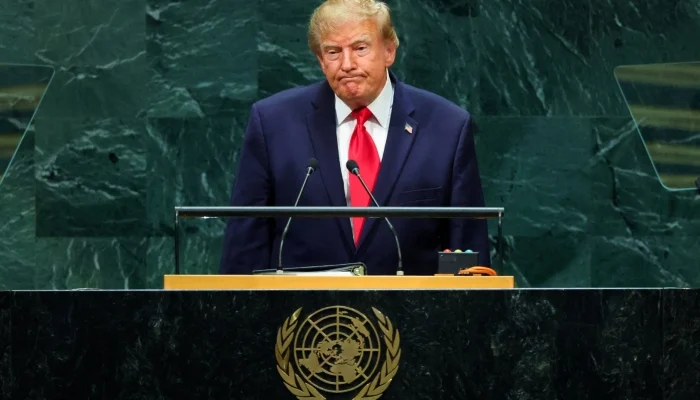
UNITED NATIONS: US President Donald Trump on Tuesday warned that he could “annihilate” Iran if no agreement is reached to end the war, while also suggesting that a deal could be possible soon as diplomatic efforts intensified on the sidelines of the United Nations General Assembly.
“I have a big decision to make,” Trump said in his address to the UNGA in New York, presenting Iran with a choice between reaching a deal and facing further military action.
Trump’s remarks came as the United States and Iran continued indirect discussions through mediators seeking to end the nearly seven-month conflict, which began with US and Israeli strikes and has killed thousands, disrupted regional trade and pushed up energy prices.
US envoy Steve Witkoff said Washington and Tehran held lengthy discussions on Tuesday through mediators who shuttled between the two sides throughout the day.
The mediators would continue their efforts, Witkoff said, expressing hope that the talks would prove constructive and promising.
Iran’s Armed Forces, however, dismissed Trump’s UN remarks as “propaganda” and warned that Iranian forces remained prepared to respond to any aggression.
Iranian Foreign Minister Abbas Araqchi also held talks with Qatar’s Prime Minister Sheikh Mohammed bin Abdulrahman Al Thani, with Doha continuing its efforts to facilitate dialogue and de-escalation.
A senior Iranian official told Reuters that Tehran had conveyed its latest proposal to Washington through mediators and could reopen the Strait of Hormuz to Gulf shipping within seven days if its demands were met.
The Strait of Hormuz has remained at the centre of the conflict because it handles a major share of global oil and gas shipments. Gulf states have urged efforts to restore shipping while remaining cautious about Iran’s regional influence.
Trump also met leaders of Middle Eastern countries during the UNGA and said the situation with Iran could potentially end after the November 3 US midterm elections or even before them.
Meanwhile, Iranian Parliament Speaker Mohammad Baqer Qalibaf rejected the prospect of Tehran surrendering to US pressure, saying Trump could not impose his power on the Iranian people and armed forces.
Gulf states seek wider security framework
The widening regional conflict has also prompted discussions over a broader security arrangement involving Iran and the Arab Gulf states.
Regional sources said Qatar had proposed a common security framework, with one source saying Iran was reviewing the proposal.
Sheikh Mohammed said any such arrangement would need to provide security guarantees for Gulf states while also expanding economic interdependence with Iran.
Saudi Arabia has been drawn deeper into the conflict amid the advance of Iran-aligned Houthi fighters in Yemen and threats to Saudi oil exports through the Red Sea.
US Secretary of State Marco Rubio said Washington would continue to support Saudi Arabia but described the Yemen conflict as dangerous and complex.
Oil markets received some relief on Tuesday after sources said Saudi Arabia had restarted operations on its East-West Pipeline and could resume exports from the Red Sea port of Yanbu within hours, although at reduced volumes.
The pipeline provides Saudi Arabia with an alternative route for oil exports that bypasses the Strait of Hormuz and had been shut following attacks that Riyadh blamed on Iranian-backed groups in Iraq.
The diplomatic efforts and military tensions continue to carry wider implications for Gulf security, global energy markets and regional stability.