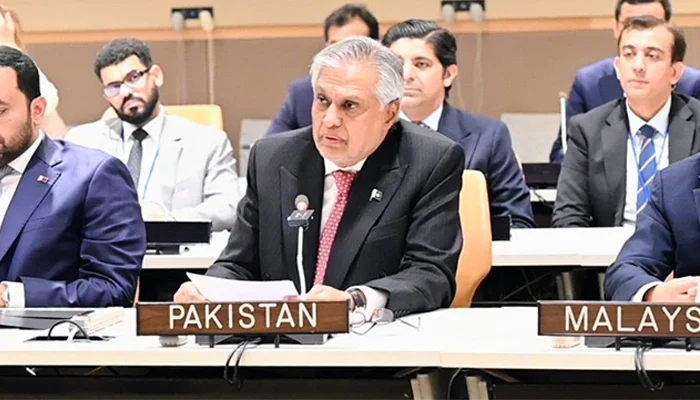
NEW YORK: Deputy Prime Minister and Foreign Minister Senator Mohammad Ishaq Dar has called for concrete and verifiable action to prevent Afghan soil from being used for terrorism against neighbouring countries, particularly Pakistan.
Addressing a meeting of the Organisation of Islamic Cooperation (OIC) Contact Group on Afghanistan on the sidelines of the 81st session of the United Nations General Assembly in New York, Dar expressed serious concern over the presence of terrorist groups inside Afghanistan and recalled Pakistan’s sacrifices in the fight against terrorism.
Referring to the recent terrorist attack in Kohat, Khyber Pakhtunkhwa, he said the loss of innocent lives and injuries caused by the attack were a stark reminder of the threat posed by terrorism emanating from the region.
Dar stressed the urgent need for concrete action against terrorist groups and their sanctuaries and urged the Afghan Taliban to fulfil Afghanistan’s international obligations and commitments.
He called on the Afghan authorities to end what Pakistan describes as patronage of terrorist groups and to take effective measures to prevent Afghan territory from being used against neighbouring countries.
The deputy prime minister also called for restrictions on women and girls in Afghanistan to be lifted, saying such restrictions were contrary to Islamic principles and the norms of Muslim societies.
He urged the Afghan authorities to promote politically inclusive governance and facilitate the resettlement and integration of Afghan returnees.
Dar also called for adequate international funding to address Afghanistan’s humanitarian needs and support its socio-economic development.
Reiterating Pakistan’s consistent policy, he said Islamabad supported a stable and prosperous Afghanistan that was at peace with itself and its neighbours.
Dar is in New York as part of Prime Minister Shehbaz Sharif’s delegation for the 81st session of the UN General Assembly.
Dar raises Kashmir, Indus Waters Treaty issues
Separately, Dar addressed the OIC Contact Group on Jammu and Kashmir and thanked the group and the OIC’s Independent Permanent Human Rights Commission for their continued support for the Kashmiri people.
He said Kashmiris had been waiting for decades to exercise their right to self-determination under the UN framework and accused India of taking measures since August 5, 2019, aimed at altering the demographic composition of Indian-administered Jammu and Kashmir.
Dar also alleged that Kashmiri political leaders and young people were being targeted under stringent laws and that restrictions were being imposed on journalists and international observers.
The deputy prime minister also criticised India’s decision to hold the Indus Waters Treaty in abeyance, saying the treaty was a binding international agreement and contained no provision permitting its unilateral suspension.
He said the Court of Arbitration had reaffirmed that unilateral action by one party could not deprive it of the court’s competence and had underscored the continuing force of the treaty’s obligations, including those concerning the Western Rivers.
Dar stressed that international obligations could not be set aside when they became inconvenient and said treaties and international commitments must be respected in good faith.
He also referred to the Pakistan-India conflict in May 2025, saying it demonstrated the risks associated with leaving the Kashmir dispute unresolved.