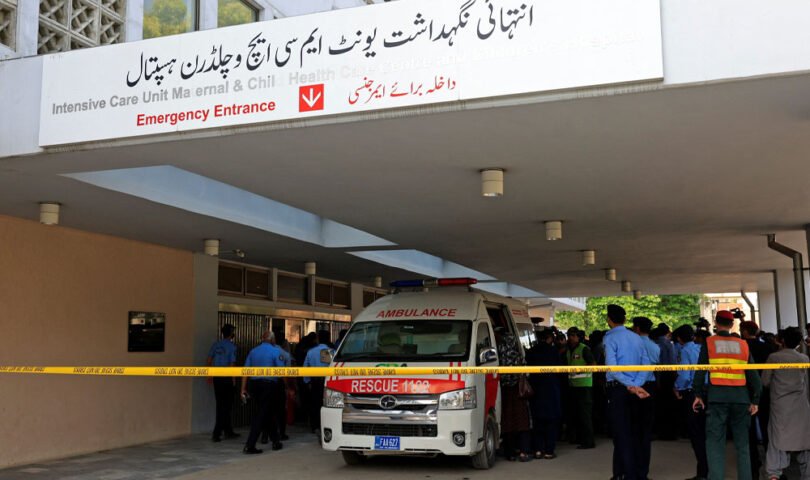
ISLAMABAD: A newborn girl rescued from the Pakistan Institute of Medical Sciences (PIMS) nursery fire has died after spending 22 days under treatment at the hospital, according to her death certificate.
The baby died on September 17 after suffering cardiac and respiratory arrest, the certificate stated. She had been admitted to PIMS on August 26 following the fire and remained under treatment until her death.
The newborn, who was from Kashmir, had developed severe complications including sepsis, disseminated intravascular coagulation (DIC) and pulmonary bleeding, according to the death certificate.
The fire broke out in the Mother and Child Hospital nursery, where 15 critically ill newborns were being treated despite the unit having capacity for 10 infants. Fourteen newborns died in the blaze, while Staff Nurse Razia Noreen rescued one baby from the burning nursery.
The rescued newborn’s condition remained critical after the incident and deteriorated amid the serious medical complications before she died on Wednesday.
Inquiry identifies electrical fault
The final inquiry report into the fire, released on September 15, concluded that an electrical fault involving the supply cable of air-conditioner No. 2 was the most probable source of ignition.
Investigators said the fault may have involved localised electrical heating, excessive current, a high-resistance connection or another defect that damaged the cable insulation and ignited nearby combustible material.
The inquiry found no evidence of arson, multiple ignition points, an external electrical fault attributed to IESCO, an oxygen leak or an incubator or warmer being the source of the fire.
However, the report said the electrical fault alone could not explain the scale of the tragedy and identified systemic and institutional failures involving fire safety, clinical management, maintenance, emergency preparedness and oversight.
Fire safety, evacuation failures
The inquiry found that the nursery lacked automatic smoke detection, an alarm and a sprinkler system. It also found no record of an approved, trained and regularly practised evacuation procedure specifically designed for newborns.
Only two doctors and two nurses were present when the fire broke out, while many infants required oxygen or respiratory support, making their evacuation particularly difficult.
CCTV footage showed the emergency developing rapidly, with the fire becoming visible at around 6:38pm.
The report said frontline staff, including Charge Nurse Nasreen Akhtar, security guard Maria Saleem and Staff Nurse Razia Noreen, acted within moments to rescue the babies.
Noreen rescued one newborn and attempted to re-enter the nursery, while Dr Muhammad Abdul Rehman was also present at the scene.
The inquiry rejected the broad allegation that frontline staff had simply abandoned the infants, saying available evidence showed several personnel had acted promptly under extremely difficult circumstances.
Delayed external response questioned
The report also raised concerns over the delay in activating external assistance.
According to Capital Emergency Services records, external notification was made at 6:54pm, dispatch took place at 6:55pm and the emergency team arrived at 7:01pm.
The inquiry described the gap between the fire becoming apparent and external assistance being activated as unacceptable, saying PIMS had failed to demonstrate an effective incident command system capable of immediately triggering alarms, evacuation, external notification and a coordinated emergency response.
Previous warnings ignored
The inquiry found that the fire occurred despite previous warnings about safety deficiencies at PIMS.
Correspondence from the Capital Development Authority and recommendations issued by the Federal Ombudsman in 2015 had identified safety shortcomings, while PIMS itself acknowledged in 2025 that its fire-safety infrastructure was outdated.
A fire at the nursing hostel on July 6, 2026 had also highlighted weaknesses in fire detection, alarms, electrical inspections, evacuation procedures, firefighting equipment and emergency planning.
The inquiry said these warnings were not translated into a comprehensive, time-bound and independently verified corrective programme before the nursery fire.
Senate panel seeks accountability
The findings have also come under scrutiny from the Senate Functional Committee on Human Rights, which on September 16 questioned the delay in registering an FIR and sought explanations over the officials being held responsible.
The committee questioned why former PIMS Executive Director Imran Sikandar was allegedly absent from the list of officials under consideration despite the interim inquiry report having recommended his suspension and departmental proceedings.
The interim report had recommended action against eight officials, including Sikandar, while the prime minister subsequently approved departmental and criminal proceedings.
The committee also questioned Islamabad police over the delay in registering an FIR despite earlier directions to initiate criminal proceedings.
Police officials told the panel that a daily diary entry had been prepared and an FIR would be registered. Senators, however, objected that a diary entry could not substitute for an FIR in a case involving 14 deaths.
The inquiry recommended further criminal investigation into possible negligence in the maintenance of the air-conditioning unit, obstruction of an emergency route, failure to act on previous warnings and any culpable delay in seeking external assistance.
It stressed that individual responsibility should be determined on the basis of evidence establishing each official’s duties, knowledge, omissions and the consequences of those omissions.