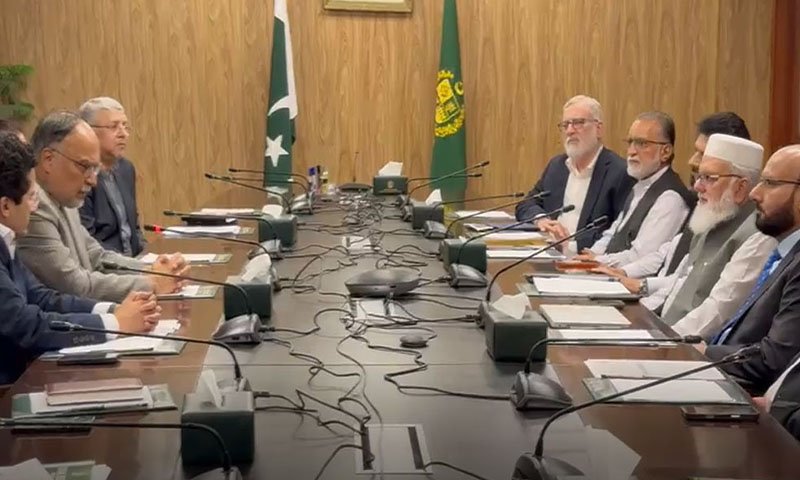
ISLAMABAD: The government on Monday assured Jamaat-e-Islami (JI) that it would consider the party’s proposals for providing relief to consumers facing rising petrol and diesel prices, with another round of talks scheduled after three days.
Planning Minister Ahsan Iqbal said the government was making efforts to provide maximum relief to the public amid a surge in global oil prices driven by tensions between Iran and the United States.
Speaking at a joint press conference after talks with JI leaders, Iqbal said the increase in oil prices was not limited to Pakistan and that global prices had risen because of uncertainty in the region.
“If tensions in the region ease, oil prices will also come down,” Iqbal said, adding that the government was also working to help reduce tensions in the region.
He said the government would examine the proposals presented by JI and forward them to the relevant ministries for consideration.
Iqbal said the next round of negotiations would be held after three days, adding that the government welcomed constructive proposals from political parties.
“Every government wants to create ease for the people,” he said.
JI presents six proposals
JI Deputy Chief Liaquat Baloch said the party had presented six proposals aimed at providing relief to the public, including withdrawal of the Rs80-per-litre petroleum levy imposed on petrol and diesel.
He also called for cuts in non-development expenditure, saying the government should reduce its own expenses instead of placing the burden on consumers.
Baloch said the first round of talks was held in a cordial atmosphere and expressed hope that the next round would result in concrete measures to provide relief to the public.
He said JI had chosen negotiations as its preferred course of action while maintaining that peaceful protest was a constitutional right of every political party.
“Jamaat-e-Islami is not making any unreasonable demand. We are seeking relief for the people,” Baloch said.
JI chief Hafiz Naeemur Rehman said the party’s negotiating team had presented its proposals with detailed arguments, while the government had sought time to consult various departments before responding.
“Our team held detailed negotiations with the government team,” he said, adding that Liaquat Baloch had formally placed the party’s proposals before the government.
Rehman said JI had taken to the streets to raise issues affecting the public and reiterated the demand for abolition of the petroleum levy.
He criticised the government’s tax policy, saying farmers, students and workers were being burdened with taxes while ordinary people were already struggling with repeated increases in fuel prices.
IMF programme complicates relief measures
The negotiations come as rising global oil prices and regional tensions put additional pressure on Pakistan’s economy, which remains under an International Monetary Fund programme.
The government has sought to cushion consumers from external price shocks while maintaining its fiscal commitments under the IMF programme.
A major reduction in petroleum levies could therefore have significant fiscal implications for the government.
Both sides agreed to continue discussions, with the next round expected to focus on the financial implications of JI’s proposals and possible measures to reduce the burden on consumers.