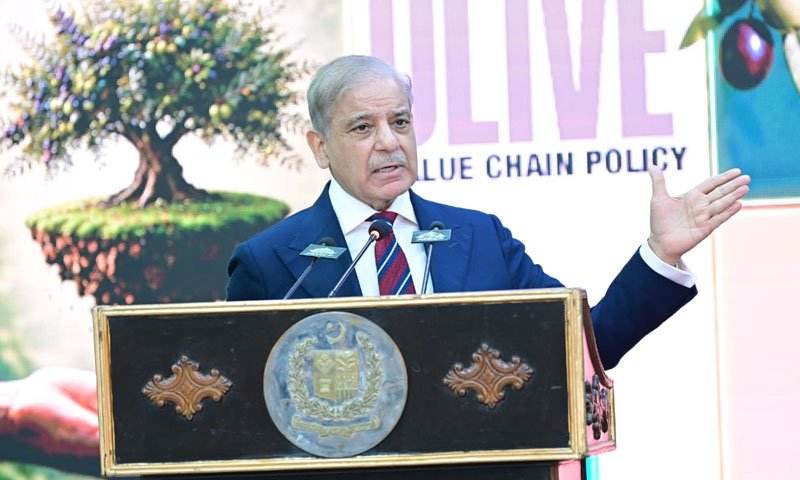
ISLAMABAD: Prime Minister Shehbaz Sharif on Monday announced that Pakistan will send 100 agricultural graduates to Italy for advanced training in olive cultivation, processing, marketing and various aspects of the value chain.
Addressing the launch ceremony of the Pakistan National Olive Value Chain Policy in Islamabad, the prime minister said practical measures were essential to bring an agricultural revolution in the country and pledged that the government would provide farmers with all possible facilities.
Shehbaz said Pakistan could achieve self-sufficiency in edible oil production by promoting olive cultivation, helping save valuable foreign exchange.
“Pakistan imports edible oil worth around $4 billion every year,” the prime minister said, adding that even reducing the annual import bill by $400 million would be a significant achievement.
He said he had also directed authorities to promote palm oil and sunflower cultivation to reduce the country’s dependence on imported edible oil.
Pakistan-Italy cooperation
The prime minister highlighted longstanding trade and economic ties between Pakistan and Italy, particularly cooperation in agriculture and tractor manufacturing.
He said the two countries would further expand cooperation in olive production, value addition, modern processing and exports.
The 100 agricultural graduates sent to Italy will receive modern training in olive cultivation, processing, marketing and different segments of the value chain, he added.
Shehbaz praised Pakistani farmers, researchers and exporters for their efforts to develop the olive sector, saying their commitment, hard work and adoption of modern techniques had produced encouraging results.
He particularly appreciated olive growers Abdul Jabbar from Loralai, Qurrat-ul-Ain from Mardan and Yaqoob Izhar from Chakwal.
The prime minister said the federal and provincial governments would work together to facilitate farmers and provide the support required to promote agricultural development.
Government focuses on olive value chain
Federal Minister for National Food Security and Research Rana Tanveer Hussain said the government would provide farmers with high-quality, disease-free seeds and use technology to identify and address potential crop losses in a timely manner.
He said olive was not merely a crop but represented a complete value chain capable of creating new business opportunities.
Rana Tanveer described Pakistan’s permanent membership of the International Olive Council as a major achievement and said the country would benefit from modern research, technology, training and international certification.
He added that Pakistan and Italy would expand cooperation in the olive sector through joint projects.
Secretary of National Food Security and Research Aamir Ali Ahmed said the launch of the National Olive Value Chain Policy was a welcome development and expressed confidence that Pakistan would soon begin exporting olive oil to markets in South, East and Central Asia.
He stressed the need for Pakistan to move beyond traditional agricultural practices and focus on production, processing, value addition, quality, branding and marketing.
Olive cultivation expands across Pakistan
Italian Ambassador to Pakistan Ogo Chiara Tallani said Pakistan and Italy had a longstanding partnership, with bilateral cooperation expanding in agriculture, science, education, trade and security.
He said the National Olive Value Chain Policy was the result of a long process and highlighted the significant expansion of olive cultivation in Pakistan.
According to the ambassador, Pakistan had around 500,000 olive trees in 2016, while more than seven million olive plants are now being cultivated across the country.
He said more than 700 stakeholders associated with the olive value chain had received training, while the Olive Culture Project was providing support to Pakistan’s olive sector.
At the ceremony, olive growers from different parts of the country shared their experiences with the prime minister.
Abdul Jabbar, an olive grower from Loralai, said expanding olive cultivation could help Pakistan reduce its debt burden and contribute to economic growth.
Qurrat-ul-Ain Irfan from Mardan said it took around 15 years to obtain olive production and expressed hope that output would increase significantly and contribute to foreign exchange earnings.
Yaqoob Izhar, an olive grower from Chakwal, said he decided to cultivate olives after attending an exhibition in London.
Earlier, Prime Minister Shehbaz distributed shields among olive growers, researchers and experts and visited stalls showcasing different olive products.
He also interacted with farmers and entrepreneurs involved in olive production from different parts of the country.