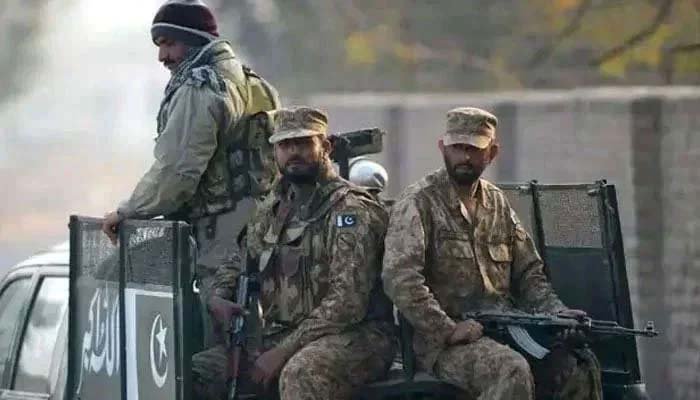
RAWALPINDI: At least two terrorists were killed and three others injured during an intelligence-based operation in Balochistan’s Killi Zaik area, security sources said on Monday.
The operation was conducted between Killi Zaik and Kaghli, around 12 kilometres north of the Baseema camp, after security forces received information about the presence of terrorists in the area.
Security forces recovered ammunition, hand grenades, magazines and material used for preparing improvised explosive devices (IEDs) from the militants, according to security sources.
The operation was carried out as part of the ongoing Operation Rad-ul-Fitna-3, which the military’s media wing has described as a counterterrorism campaign targeting Indian proxies.
The latest operation came a day after security forces killed seven India-backed terrorists during an intelligence-based operation in Kharan district.
That operation was conducted in the Lajay area after security forces received information about the presence of militants there.
Pakistan has witnessed a surge in terrorist activity, particularly in Khyber Pakhtunkhwa and Balochistan, since 2021, when the Afghan Taliban returned to power in Afghanistan.
According to a report by the Centre for Research and Security Studies (CRSS), Khyber Pakhtunkhwa and Balochistan remained the country’s main hotspots for violence during the second quarter of 2026.
The report identified Khyber Pakhtunkhwa as the worst-affected region, accounting for more than 61 per cent of violence-related fatalities, with 475 deaths recorded during the quarter. Balochistan accounted for another 34 per cent, with 265 fatalities.
Together, the two provinces accounted for nearly 96 per cent of all violence-related deaths recorded across Pakistan during the period.
Khyber Pakhtunkhwa also recorded the highest number of violent incidents, with 151 cases, representing 57 per cent of the nationwide total, while Balochistan reported 94 incidents, accounting for 35 per cent.
Security forces continue to conduct intelligence-based operations across Balochistan and Khyber Pakhtunkhwa as part of efforts to disrupt militant networks and prevent further terrorist attacks.