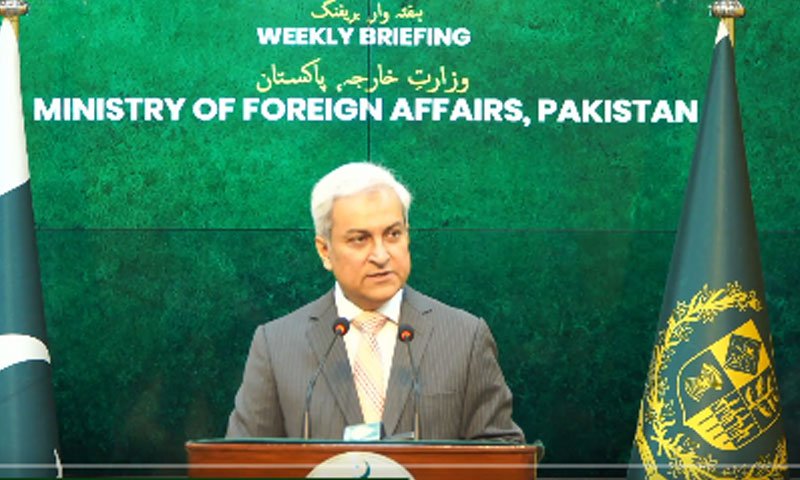
ISLAMABAD: Pakistan on Thursday strongly rejected India’s criticism of the ongoing Azad Jammu and Kashmir (AJK) Legislative Assembly elections, saying New Delhi has “neither the standing nor the moral authority” to question the democratic process while continuing to deny political rights to the people of Indian Illegally Occupied Jammu and Kashmir (IIOJK).
Speaking at the Foreign Office’s weekly media briefing, spokesperson Tahir Andrabi dismissed the Indian Ministry of External Affairs’ statement describing the AJK elections as a “farce”, calling the remarks baseless and politically motivated.
Andrabi said it was unsurprising that India issued the statement on the eve of the seventh anniversary of its August 5, 2019 actions, when New Delhi revoked the special constitutional status of occupied Jammu and Kashmir, a move Pakistan says violated United Nations Security Council resolutions, international law and India’s international commitments.
He said the AJK elections were being conducted peacefully, transparently and in accordance with the constitutional and legal framework governing the region.
“The ongoing elections reflect the democratic aspirations and political will of the people of Azad Jammu and Kashmir,” Andrabi said.
He added that India, because of its continued denial of democratic freedoms and political rights in occupied Kashmir, had no moral or legal standing to comment on the democratic process in AJK.
The spokesperson said India’s attempts to spread misinformation and propaganda could not alter the internationally recognised disputed status of Jammu and Kashmir, reiterating that its final settlement must be determined through a UN-administered plebiscite in accordance with relevant UN Security Council resolutions and the wishes of the Kashmiri people.
Responding to India’s criticism of Deputy Prime Minister and Foreign Minister Ishaq Dar’s Youm-e-Istehsal statement, Andrabi described New Delhi’s response as a self-serving defence of its policies in occupied Kashmir.
He said heavy military deployment and stringent security laws continued to facilitate demographic changes aimed at altering the Muslim-majority character of the territory, while infrastructure projects could not replace the Kashmiri people’s internationally recognised right to self-determination.
Reaffirming Pakistan’s position, the spokesperson called on India to reverse its “illegal and unilateral” measures and engage in a peaceful resolution of the Kashmir dispute in line with UN Security Council resolutions.
Turning to regional developments, Andrabi said Pakistan remained actively engaged with friendly countries to help reduce tensions in the Gulf and the wider Middle East, particularly regarding the situation surrounding the Strait of Hormuz.
He praised Oman’s diplomatic efforts to promote dialogue, de-escalation and regional stability, saying Pakistan would continue supporting all sincere initiatives aimed at achieving a comprehensive and lasting resolution to the crisis.
The spokesperson said Deputy Prime Minister Ishaq Dar spoke with Saudi Foreign Minister Prince Faisal bin Farhan on July 30 to discuss developments in the Red Sea, Bab al-Mandeb and Palestine. On August 3, Dar also held a telephone conversation with Iranian Foreign Minister Seyyed Abbas Araghchi, discussing the situation in Occupied East Jerusalem and other regional developments while extending an invitation for him to visit Pakistan.
Andrabi said Dar travelled to Amman on August 5 to participate in the Ministerial Meeting on Jerusalem at the invitation of Jordanian Deputy Prime Minister and Foreign Minister Ayman Safadi.
During the meeting, Pakistan reaffirmed its unwavering support for the Palestinian people and reiterated its commitment to the establishment of an independent, sovereign and contiguous Palestinian state based on the pre-1967 borders, with Al-Quds Al-Sharif as its capital.
On the sidelines of the conference, Dar held bilateral meetings with the foreign ministers of Jordan, Türkiye, Egypt, Algeria, Iraq and Somalia. He also participated in the fifth meeting of the R-4 Group, comprising Egypt, Pakistan, Saudi Arabia and Türkiye, where the ministers reaffirmed support for Palestinian self-determination and stressed the importance of continued diplomatic coordination for regional peace.
Highlighting Pakistan-US relations, Andrabi said the fourth round of the Pakistan-US Counterterrorism Dialogue was held in Washington on August 5 under the leadership of Pakistan’s Special Secretary Ambassador Nabeel Munir.
He said both countries reaffirmed their commitment to combating terrorism, strengthening border security cooperation and countering militant organisations, including Islamic State Khorasan (ISIS-K), Al-Qaeda, Tehreek-e-Taliban Pakistan (TTP) and the Balochistan Liberation Army (BLA).
The spokesperson also announced that Pakistan and Australia held the ninth round of Senior Officials Talks and the Joint Trade Committee Meeting in Canberra on August 4, reviewing bilateral cooperation in political, economic, trade, security and regional affairs while reaffirming their commitment to further strengthening relations.
Concluding the briefing, Andrabi recalled Pakistan’s observance of Youm-e-Istehsal on August 5 and reiterated Islamabad’s continued diplomatic, political and moral support for the Kashmiri people’s right to self-determination in accordance with United Nations Security Council resolutions.