Iran said on Monday it was working to establish a joint mechanism with Oman to manage the Strait of Hormuz but claimed that United States pressure on Muscat had delayed progress.
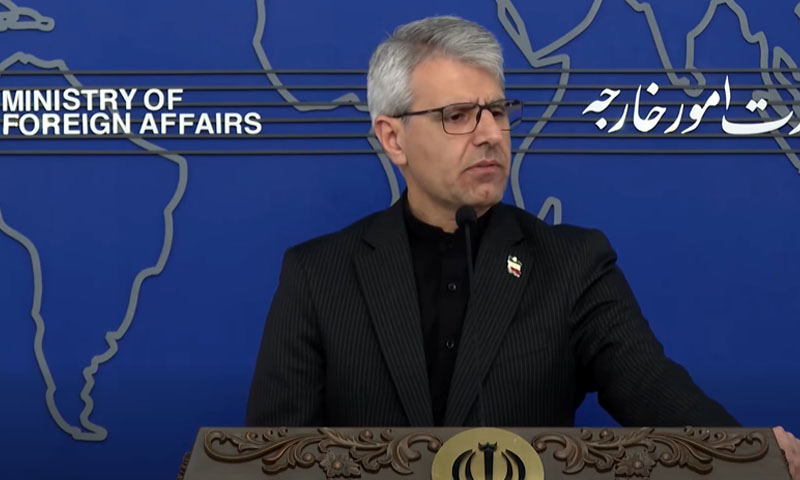
Speaking at a press briefing, Iranian Foreign Ministry spokesperson Esmaeil Baghaei said Tehran was seeking an agreement with Oman on managing the strategic waterway but alleged that Washington’s pressure had hindered the initiative.
Baghaei also reiterated that Iran would not implement its commitments under the memorandum of understanding (MoU) with the United States unless Washington fulfilled its own obligations.
He said Tehran’s compliance with the agreement depended on reciprocal action by Washington, adding that Iran would not honour its commitments while the United States failed to meet its responsibilities.
The remarks came a day after US and Iranian forces exchanged missile and drone strikes, with Tehran targeting US military facilities across Gulf states and claiming it had again closed the Strait of Hormuz, pushing global oil prices higher.
Iran’s Revolutionary Guards said they targeted US military installations in Bahrain and Kuwait, destroyed radar systems in Oman and struck fuel storage facilities and ammunition depots at Jordan’s Prince Hassan Air Base in response to a fresh wave of US attacks.
The United States military said it had struck Iranian air defence systems, coastal radar installations, missile and drone capabilities and small naval vessels using aircraft, warships and drones during operations on Sunday.
The renewed hostilities have cast further doubt on the future of the interim US-Iran agreement signed last month, which aimed to reopen the Strait of Hormuz and pave the way for further negotiations.
In a brief interview with Reuters, US President Donald Trump defended the military campaign, saying, “We’re beating them up.”
Iran’s chief negotiator Mohammad Baqer Ghalibaf wrote on X that the era of one-sided agreements was over, warning Washington to honour its commitments or face consequences.
The conflict, which began with US and Israeli military action against Iran on February 28, has intensified instability across the Gulf, where Iran has launched attacks on US military facilities in several countries.
Iran’s effective blockade of the Strait of Hormuz has disrupted global energy markets, driving up oil prices and increasing concerns over inflation.
The Revolutionary Guards said the only way to restore normal shipping through the waterway was for the United States to end its military operations in the region, warning that continued intervention could trigger further disruption to the global oil and gas market.
Brent crude rose 4.3 per cent to $79.31 per barrel on Monday, although prices remained below the peaks recorded earlier in the conflict.
US officials said around 20 vessels had been escorted safely through the Strait of Hormuz during the previous 24 hours, despite reduced commercial traffic.
Iran has sought to establish a permanent system for regulating shipping through the strait, which previously handled around one-fifth of global oil and liquefied natural gas exports.
Iranian authorities said the waterway remained closed due to what they described as recent unlawful US military activities in the region, adding that shipping permits would only be issued once stability had been restored.
The United States rejected Iran’s claims, insisting that freedom of navigation remained intact and that US forces were committed to safeguarding international shipping through the strategic waterway.
US Central Command said more than 300 Iranian military targets had been struck over the past three nights, including 140 targets on Saturday alone, in operations aimed at reducing Iran’s ability to threaten commercial shipping in the Strait of Hormuz.