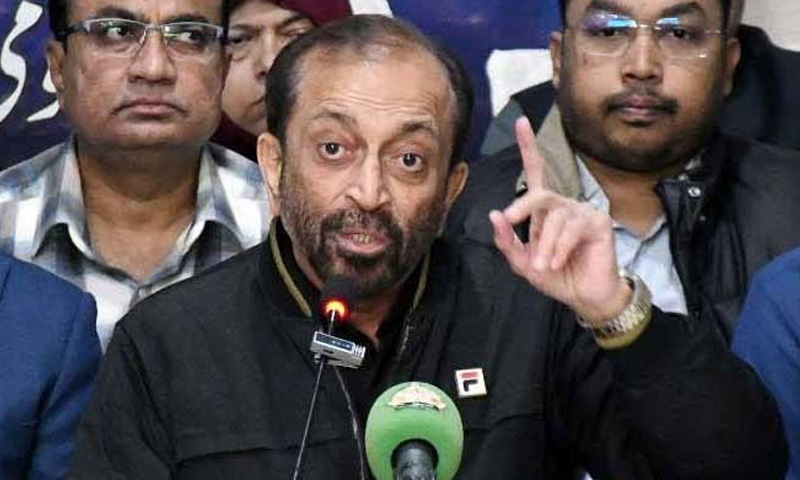
KARACHI: The Muttahida Qaumi Movement-Pakistan (MQM-P) on Sunday threatened to quit the federal coalition government, warning that its lawmakers would move to the opposition benches if its long-standing demands were not fulfilled.
Addressing a press conference in Karachi, MQM-P senior leader Dr Farooq Sattar issued what he described as a “final warning” to the federal government, saying the party would sit in the opposition if key agreements remained unimplemented.
He said the party’s 22 members of the National Assembly would formally write to the National Assembly speaker seeking allocation of opposition benches if issues relating to the recovery of missing party workers, implementation of local government empowerment under Article 140-A of the Constitution, the Sindh governorship and a development package for Karachi were not addressed.
“In 2022, an agreement was signed between the Pakistan Peoples Party and MQM-P, which was witnessed and guaranteed by Prime Minister Shehbaz Sharif himself,” Sattar said.
“This is our final warning. The prime minister must ensure the implementation of this accord.”
Sattar, whose party is a key ally in the Pakistan Muslim League-Nawaz-led coalition government, also called for the creation of a separate administrative unit to place Karachi under the federal government’s management.
He further urged the federal government to clarify the status of the Sindh governor.
The MQM-P’s announcement drew a strong response from the Pakistan Peoples Party.
Sindh Senior Minister Sharjeel Inam Memon described the party’s warning as “political blackmail” and accused the MQM-P of attempting to shift attention away from its own political shortcomings.
“Using federal intervention for political pressure is clear evidence of blackmailing. MQM-P has lost the public’s trust and is now looking for shortcuts,” Memon said in a statement.
He termed the demand to hand Sindh’s affairs to the federation a conspiracy against the country’s federal structure.
Memon said the people of Sindh had given the PPP a clear democratic mandate, which could not be changed through political pressure or threats.
He advised the MQM-P to raise its concerns with its coalition partners in the federal government instead of targeting the Sindh government.
The MQM-P holds 22 seats in the National Assembly, while Prime Minister Shehbaz Sharif’s coalition government depends on its allies to maintain its majority in the lower house of parliament.