ISLAMABAD: Information Minister Attaullah Tarar on Monday said the Indus Waters Treaty cannot be unilaterally suspended or altered, asserting that Pakistan’s rights over the Indus river system remain protected under the legally binding agreement.
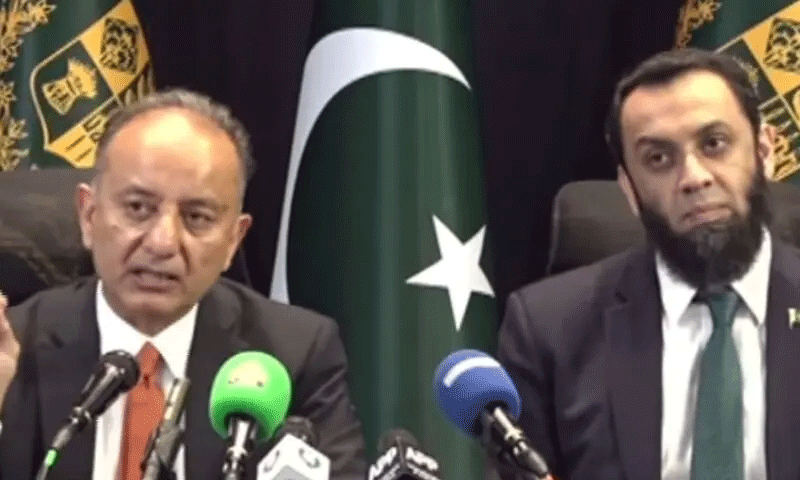
Addressing a joint press conference with Climate Change Minister Musadik Malik in Islamabad, Tarar said the treaty provides a clear legal framework that continues to remain in force despite recent tensions over water sharing.
His remarks came after India last year placed the treaty in abeyance following a brief military conflict in May 2025 and declared it would prevent water from flowing into Pakistan, a move Islamabad has described as an act of war.
Tarar said Prime Minister Shehbaz Sharif and Chief of Army Staff Syed Asim Munir had consistently described water as Pakistan’s lifeline and red line.
He said Pakistan’s position had gained international support, adding that the country’s legal and diplomatic narrative had been recognised on global forums while India’s stance had been rejected.
The information minister announced that a seminar would be held in Islamabad on Tuesday, bringing together international water and legal experts to discuss Pakistan’s rights under the Indus Waters Treaty.
Speaking on the occasion, Musadik Malik warned that any disruption to Pakistan’s water share would have serious implications for agriculture, food security and the national economy.
He said nearly half of Pakistan’s population depends on agriculture for its livelihood, while the sector contributes around one-quarter of the country’s economy.
Malik questioned whether an upper riparian state could lawfully stop water flows to a lower riparian country, noting that international conventions protect downstream water rights even where no formal treaty exists.
The ministers said Pakistan would continue pursuing its case on the basis of international law and justice while also seeking national consensus on the construction of new dams to improve water management.
Brokered by the World Bank in 1960, the Indus Waters Treaty allocates the eastern rivers — Ravi, Beas and Sutlej — to India, while granting Pakistan primary rights over the western rivers — Indus, Jhelum and Chenab. Pakistan has also secured favourable rulings from the Permanent Court of Arbitration regarding the implementation of the treaty and India’s hydroelectric projects.