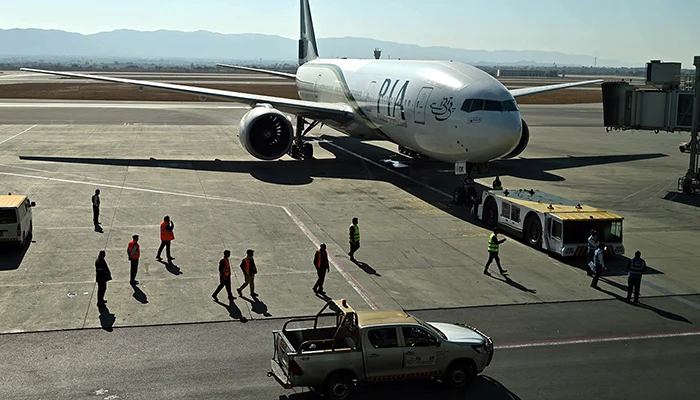
KARACHI: At least 11 international flights awaiting departure have been stranded at airports across Pakistan for the past three days as the Middle East crisis deepens following US-Israel strikes on Iran.
Israel and the United States launched coordinated attacks on Iran, killing Supreme Leader Ali Khamenei and triggering a renewed regional confrontation as US President Donald Trump vowed to dismantle Tehran’s missile arsenal and prevent it from developing nuclear weapons.
Tehran responded with a sweeping barrage of missiles targeting Gulf states and Israel, sharply escalating hostilities and disrupting aviation operations across the region.
A foreign airline flight has remained grounded at Multan airport for three days, while two other internationally operated airlines are awaiting departure clearance at Sialkot Airport.
Meanwhile, overflights through Pakistani and Afghan airspace have surged as airlines reroute to avoid closed corridors in the Middle East. According to Flightradar data, several routes passing through Pakistan and Afghanistan have become among the busiest in the world.
Global air travel remained heavily disrupted on Sunday as continued air strikes kept major Middle Eastern airports — including Dubai, the world’s busiest international hub — closed in one of the sharpest aviation shocks in recent years.
Key transit hubs such as Abu Dhabi in the UAE and Doha in Qatar were also shut or severely restricted as much of the region’s airspace remained closed, creating widespread uncertainty across the Gulf.
The airport shutdowns have had ripple effects far beyond the Middle East. Dubai and Doha serve as critical crossroads linking Europe and Asia through tightly scheduled long-haul connections. With those hubs offline, aircraft and crews have been stranded out of position, disrupting airline schedules globally.
Airlines across Europe, Asia and the Middle East have cancelled or rerouted flights to avoid restricted airspace, lengthening journeys and increasing fuel costs. The disruption has been compounded by the continued loss of Iranian and Iraqi overflight routes, which had become increasingly important after airlines began avoiding Russian and Ukrainian airspace due to the ongoing war.
Ian Petchenik, communications director at Flightradar24, said the Middle East airspace closures were squeezing airlines into narrower corridors, with additional risks emerging from instability along the Pakistan-Afghanistan region, further complicating global flight operations.